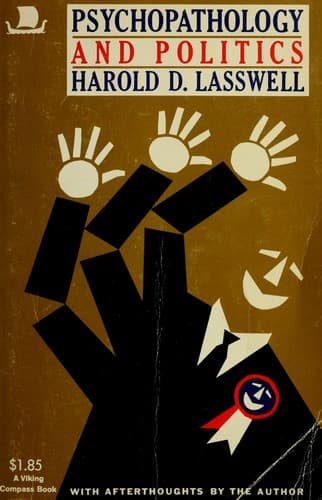
Psychopathology and politicsLasswell, Harold D. (Harold Dwight)
Science
Psychopathology and politics
Lasswell, Harold D. (Harold Dwight)
Personality and politics; Political science; Psychoanalysis; Psychology, Pathological
Now the multiplicity of human motives has always been a source
of embarrassment to people who wanted to manage men or merely to
understand them. The clumsy machinery of judicial administration has
been worked out along certain lines in the hope of introducing some
degree of uniformity into adjudication by limiting the consideration
of the motives which operate in a particular case. The judge is thus
supposed to limit himself to the determination of the existence
of a particular state of facts, and to act in a particular way if
these facts can be established according to a prescribed procedure.
The movement toward the standardization of the discretion of public
officers expresses itself in this general pattern of thought:
An act is prohibited by the state.
Certain prescribed “externals” shall establish the fact of the act
having been committed.
The actor shall be dealt with in certain specified ways.
This crusade against the subjective element in the mind of the public
officer is in some measure determined by the desire of the judge or
civil servant to avoid responsibility.[83]
The psychopathological approach precipitates something very like a
panic among those who have tried to box the manifestations of human
life into conventional common-sense categories. A dozen motives seem to
bloom where but one was found to bud before.
Let us see what this does for political theory. The prolonged study
of individuals enables us to discern the details of the process by
which the political pattern, as we meet it in adult life, comes to be
achieved by individuals.
When X runs for office or passes judgment, his behavior is
overdetermined by motives, conscious and unconscious, which were
organized in successive patterns during infancy, childhood and youth.
The recognition of belonging to a communal order never functions in
isolation, and the comparison of life-histories shows that this is
implanted in the child on the basis of meanings which he has elaborated
in his struggle, first against inhibitory factors in the environment,
and presently, when he has introjected the demands of the environment,
against his own antisocial impulses.
The early restrictions which the environment imposes upon a child
are important in that they are met by reactions on his part which
predispose him to meet subsequent limitations in certain ways. These
early restrictions are imposed upon the child by inflicting pain or
by distracting attention to pleasurable stimuli. Inhibition is thus
established in the organism by _force majeur_ on the part of the
environment, since the infant is simply overpowered or outgeneraled by
the environment.
Public-domain text, read in full here on John Shaqi.
Reviews
Reviews
No reviews yet
Be the first to share your thoughts on this work.
Elsewhere in the archive
Join the Discussion
Join the discussion
Sign in to leave a comment or review.
Sign InorCreate an account