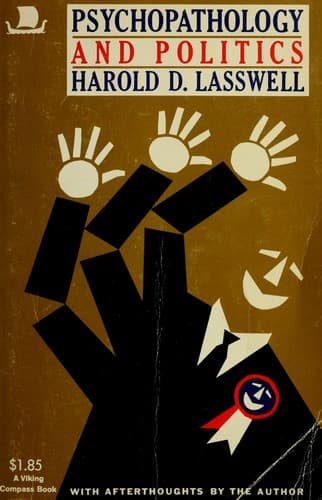
Psychopathology and politicsLasswell, Harold D. (Harold Dwight)
Science
Psychopathology and politics
Lasswell, Harold D. (Harold Dwight)
Personality and politics; Political science; Psychoanalysis; Psychology, Pathological
As a group the administrators are distinguished by the value which they
place upon the co-ordination of effort in continuing activity. They
differ from the agitators in that their affects are displaced on less
remote and abstract objects. In the case of one important group this
failure to achieve abstract objects is due to excessive preoccupation
with specific individuals in the family circle, and to the correlative
difficulty of defining the rôle of the self. Very original and
overdriving administrators show a fundamental pattern which coincides
with that of the agitators. The differences in specific development are
principally due to the culture patterns available for identification
at critical phases of growth. Another group of administrators is
recruited from among those who have passed smoothly through their
developmental crises. They have not overrepressed powerful hostilities,
but either sublimated these drives, or expressed them boldly in the
intimate circle. They display an impersonal interest in the task of
organization itself, and assert themselves with firmness, though not
with overemphasis, in professional and intimate life. Their lack of
interest in abstractions is due to the fact that they have never needed
them as a means of dealing with their emotional problems. They can
take or leave general ideas without using them to arouse widespread
affective responses from the public. Tied neither to abstractions nor
to particular people, they are able to deal with both in a context of
human relations, impersonally conceived. Their affects flow freely;
they are not affectless, but affectively adjusted.
The psychopathological method was also employed to discover the
significance of political convictions, for it is evident that beliefs
are expressive of a rational and logical “manifest” content, and that
they symbolize a host of private motives. In this connection there
was passed in review the history of a compulsive conformist to the
pattern of the family, and the histories of several nonconformists. The
private meaning of militarism and pacifism, and of the pessimism and
censoriousness of old age, were explored.
Attention was then turned from the case-history fragments to the
problem of drawing out the implications of intensive personality study
for the theory of the collective political process.
Public-domain text, read in full here on John Shaqi.
Reviews
Reviews
No reviews yet
Be the first to share your thoughts on this work.
Elsewhere in the archive
Join the Discussion
Join the discussion
Sign in to leave a comment or review.
Sign InorCreate an account