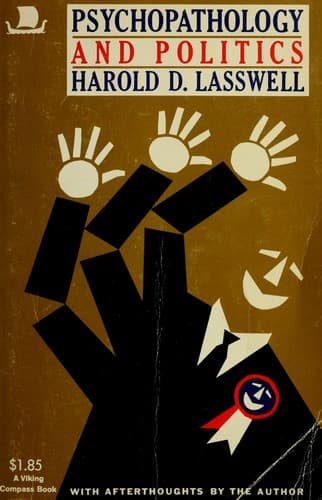
Psychopathology and politicsLasswell, Harold D. (Harold Dwight)
Science
Psychopathology and politics
Lasswell, Harold D. (Harold Dwight)
Personality and politics; Political science; Psychoanalysis; Psychology, Pathological
Reik, Theodor. _Geständniszwang und Strafbedürfnis: Probleme der
Psychoanalyse und der Kriminologie_. Leipzig, etc., 1925.
Outlines in masterly fashion the implications of the need for
punishment and the compulsion to confess for criminology.
Reik has also published extensively on religion from the
psychoanalytical standpoint.
Kohn, Erwin, _Lasalle der Führer_. Leipzig, etc., 1926.
Alexander, Franz, and Staub, Hugo. _Der Verbrecher und seine
Richter_. Vienna, 1929.
A sketch of criminology from the psychoanalytical standpoint,
drawing heavily on Alexander’s conception of the neurotic
character, as distinguished from the neurotics who show hysteric
or compulsive symptoms.
Friedjung, Josef K. “Zur Psychologie des kleinen Politikers,”
_Imago_, XIV (1928), 498-501.
Among those who have undertaken from allied fields to apply
psychoanalytic viewpoints may be mentioned William F. Ogburn, who read
a paper before the economists in 1918; Thomas D. Eliot, sociologist;
Harry Elmer Barnes, historical sociologist; E. D. Martin, social
psychologist; Preserved Smith, historian; R. V. Harlow, historian;
W. H. R. Rivers, ethnologist; and Theodore Schroeder, lawyer. See
especially:
Barnes, Harry Elmer. _The New History and the Social Studies_,
chap. iii. New York, 1925.
Discusses the bibliography in English.
Swoboda, Hermann. “Zur Psychologie des Parlamentarismus,”
_Oesterreichische Rundschau_, Band XIV, Heft 1, January 1, 1908.
----. “Die Kunst des Regierens,” _ibid._, Band XVII, December 15,
1908.
----. “Der Volksvertreter,” _ibid._, Band XXXII, Heft 3, August 1,
1912.
These articles of Swoboda are the first well-considered
applications of psychoanalysis to politics by a non-specialist.
The first article treats the rôle of parliamentarism as
“catharsis,” and specifically refers to the work of Breuer and
Freud.
Aside from specifically psychoanalytical efforts to interpret
individuals and collective trends, there have been many efforts on the
part of other psychiatrists and physicians, or their followers, to
offer such interpretations. The whole literature of “pathography” is
abstracted and discussed here:
Lange-Eichbaum, Wilhelm. _Genie-Irrsinn, und Ruhm._ Leipzig, 1928.
Students of politics will be most interested in the references and
abstracts concerning Rousseau, Alexander the Great, Amenhotep IV,
Bismarck, Blücher, emperors and princes, Frederick the Great, Lincoln,
Loyola, Ludwig II of Bavaria, Napoleon, and Robespierre. Möbius put
“pathography” on a scientific basis. The following is one of the best
of the “pathographies,” since it stresses the diseased aspects of
the personality in the perspective of the total development of the
subject’s career:
Heidenhain, Adolf, _J.-J. Rousseau, Persönlichkeit, Philosophie and
Psychose_, “Grenzfragen des Nerven-und Seelenlebens,” Heft 117.
Munich, 1924.
Public-domain text, read in full here on John Shaqi.
Reviews
Reviews
No reviews yet
Be the first to share your thoughts on this work.
Elsewhere in the archive
Join the Discussion
Join the discussion
Sign in to leave a comment or review.
Sign InorCreate an account