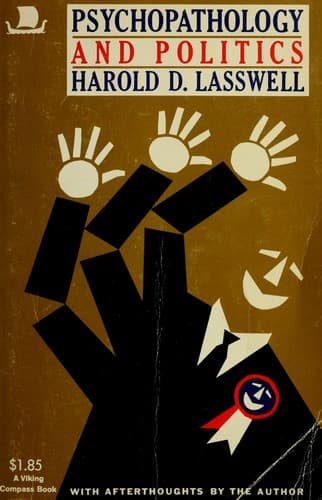
Psychopathology and politicsLasswell, Harold D. (Harold Dwight)
Science
Psychopathology and politics
Lasswell, Harold D. (Harold Dwight)
Personality and politics; Political science; Psychoanalysis; Psychology, Pathological
The study of the effect of individual pathology on culture, and of
culture upon individual pathology, is envisaged as a program in the
following:
Birnbaum, Karl. _Grundzüge der Kulturpsychopathologie_,
“Grenzfragen des Nerven- und Seelenlebens,” Heft 116. Munich, 1924.
The reckless extension of individual pathological terms to the state of
society as a whole has caused much confusion, but a case can be made
out for a valid use of the concept of the pathological. Thus:
Schneersohn, F. “Zur Grundlegung einer Völker- und
Massenpsychopathologie (Soziopsychopathologie),” _Ethos_, I
(1925-26), 81-120.
This includes an exhaustive bibliography of the efforts of
psychiatrists to extend their conceptions to society, and a
detailed consideration of the methodological issues involved.
Special attention should be called to the forthcoming volume by Harry
Stack Sullivan on _Personal Psychopathology_ in which a systematic
treatment of the whole field of psychiatry and sociology is presented.
Dr. Sullivan has vastly stimulated a _rapprochement_ between physician
and social scientist in the United States. See the _Proceedings_ of
the two colloquiums on personality investigation, held under the
auspices of the American Psychiatric Association, first published in
the _American Journal of Psychiatry_ for May, 1929, and May, 1930, and
separately obtainable.
APPENDIX B
QUESTION LIST ON POLITICAL PRACTICES
This question list refers directly to the organized political life of
the subject. Questions which are designed to elicit preferences are not
included. For general personality questions and trait lists, the usual
sources may be consulted for suggestions.[85]
The question list here must, of course, be modified if used orally or
with naïve subjects. An effort is always to be made to elicit specific
incidents which arise in the mind. “Reminiscences” and not theories
about the self are desired.
1. List the various associations and organizations of which you
have been a member and in which you enjoyed rights which were
approximately equal to those exercised by everyone else. Specify
in each case whether you were almost inactive, moderately active,
quite active. State when you became a member and how your
subsequent activity fluctuated. Give dates when possible. Remember
that you have been a member of various democratically organized
political units. Mention also the prep-school class organizations,
school and college organizations, alumni associations, profession
organizations, civic associations, parties, and elective public
offices. Organizations which were autocratically organized (that
is, which exercised authority over those who had no formal right
to choose the officials) should not be included. Do not omit
associations of war veterans, Daughters or Sons of the Revolution,
pacifists, anarchists, reform agitators, constitutional defense
leagues, etc.
Public-domain text, read in full here on John Shaqi.
Reviews
Reviews
No reviews yet
Be the first to share your thoughts on this work.
Elsewhere in the archive
Join the Discussion
Join the discussion
Sign in to leave a comment or review.
Sign InorCreate an account