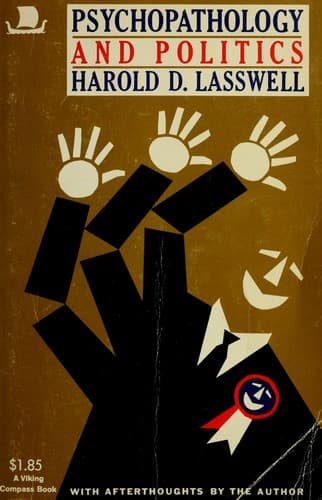
Psychopathology and politicsLasswell, Harold D. (Harold Dwight)
Science
Psychopathology and politics
Lasswell, Harold D. (Harold Dwight)
Personality and politics; Political science; Psychoanalysis; Psychology, Pathological
Wallas, Graham, 46
Weber, Max, 39, 52
Weininger, 62
Wertheimer and Hesketh, 81
White, William A., 179 n.
Willoughby, W. W., 2
Winkler, Viktor, 231
Wittals, Fritz, 22
Wordsworth, W., 70
Zilboorg, Gregory, 123
Znaniecki, F., 12
FOOTNOTES
[1] See Harold D. Lasswell, “The Study of the Ill as a Method of
Research on Political Personalities,” _American Political Science
Review_, November, 1929.
[2] “Psychosis” means the more serious mental disturbances; “neurosis”
means the less serious ones.
[3] The best summary of this literature is Wilhelm Lange-Eichbaum,
_Genie-Irrsinn und Ruhm_. See also the works of Ireland, Lombroso,
Möbius, and Gould.
[4] See De Grange’s excellent treatment of this matter in his paper on
the methodology of Comte in the case book to be published by the Social
Science Research Council.
[5] What has been said above is current in the biography of Freud by
Fritz Wittals, and in Freud’s autobiographical sketches.
[6] Modified from “Self-Analysis and Judicial Thinking,” _International
Journal of Ethics_, April, 1930.
[7] The training should, of course, be conducted by a specialist alert
to his responsibilities.
[8] “Politik als Beruf,” in _Gesammelte Schriften_.
[9] I summarized some of this literature in “Types of Political
Personalities,” _Proceedings of the American Sociological Society,
1927_. Reprinted in _Personality and the Group_ (edited by Burgess).
[10] _Personality in Politics._
[11] _The History of European Liberalism._
[12] _Physique and Character_, chap. xiii.
[13] _Quantitative Methods in Politics_, chap. v.
[14] _The Science and Method of Politics._
[15] _The New State._
[16] It is not profitable to pursue these distinctions farther. I
should prefer to distinguish the statesman from the politician by
treating the latter as a function of a democratically organized
community and as one who is limited to persuasion in the advancement of
his conceptions of public right. The statesman may use force, and is
not necessarily a function of democratically organized society.
[17] His viewpoint is best expressed in “Die Typen der Weltanschauung,”
in _Weltanschauung-Philosophie und Religion in Darstellungen_ (edited
by M. Frischeisen-Kohler).
[18] _Soziologie_, chap. iii.
[19] _Grundriss der Sozialökonomik_, III, 1.
[20] See Robert Michels, _Political Parties_; C. E. Merriam, _American
Party System_, and _Introduction_ to H. F. Gosnell’s _Boss Platt and
His New York Machine_; Martin Conway, _Instincts of the Herd in Peace
and War_; Lowell, _Public Opinion in War and Peace_; Rohmer, _Die Vier
Parteien_; A. Christensen, _Politics and Crowd Morality_; W. B. Munro,
_Personality in Politics_.
[21] _Die öffentliche Persönlichkeit._ Beihefte zur _Zeitschrift für
angewandte Psychologie_, Vol. XLIV.
[22] “Innate Factors in Radicalism and Conservatism,” _Journal of
Abnormal and Social Psychology_, XX (1925-26), 234-44.
Public-domain text, read in full here on John Shaqi.
Reviews
Reviews
No reviews yet
Be the first to share your thoughts on this work.
Elsewhere in the archive
Join the Discussion
Join the discussion
Sign in to leave a comment or review.
Sign InorCreate an account