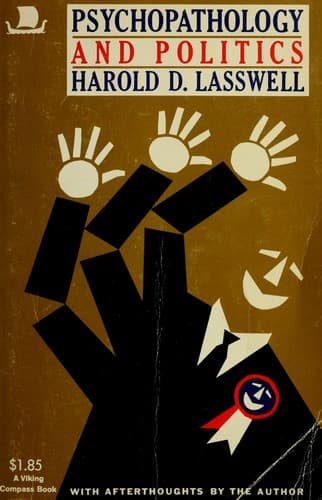
Psychopathology and politicsLasswell, Harold D. (Harold Dwight)
Science
Psychopathology and politics
Lasswell, Harold D. (Harold Dwight)
Personality and politics; Political science; Psychoanalysis; Psychology, Pathological
The popular speech of every state and neighborhood swarms with names
for varieties of political behavior and types of politicians. The study
of political differences may very well begin by sifting the common
vocabulary. Some of the popular images are derived from experience with
government officials. Within the last hundred years the policeman has
appeared over Western Europe, and a history of the popular conception
of his rôle could be written around terms like “bobby,” “cop,” and
“_Schupo_.” Whatever differences in dress, manner, social position,
and common humanity are supposed to exist between a “civil servant,” a
“_Beamter_,” and a “_fonctionnaire_,” there are common lineaments in
the composite stereotype. A thick chapter in human experience could be
entitled “The Bureaucrat,” wherein would be recorded the innuendo of
popular comment on a necessary evil. The “legislator” is identifiable
through all the detailed contrasts between the “congressman,” the
“M.P.,” and the “M.d.R.”
The popular tongue is rich in expressions which fill out the
official cast of characters in the political drama by peopling the
public stage with figures whose traits are essentially irrelevant
to their office. There are men of ideas--“anarchist,” “socialist,”
“liberal,” “communist,” “conservative.” There are men of ideas and of
action--“reformer,” “revolutionary,” “martyr.” The history of American,
British, French, German, medieval, Graeco-Roman, and every civilization
could be written for the sake of showing how the carriers of public
power figured in the eyes of the various groups within and without the
culture.
This profusion of types in the popular firmament of politics is
supplemented by the types which have been isolated by serious students
of culture, who have sought to impose order upon the life of the past.
Among the political forms which have been described by the historians,
the “benevolent despot” of the eighteenth century, the “demagogue” of
Athenian democracy, the “prince” of the Italian Renaissance, and the
“despot” of the oriental empires spring at once to mind. The masterly
sketch of the evolution of the public official with which Max Weber[8]
has enriched social science is, it is to be hoped, the forerunner of
many elaborate studies. The traits and arts of political leaders have
been most systematically handled by Aristotle, Machiavelli, Robert
Michels, Christensen, and Charles E. Merriam.[9]
These typologies, whether popular or scientific, possess several
features in common. They may converge to what is practically the same
picture. When W. B. Munro described the “reformer,” he filled out the
popular image which arose in the American mind at a certain phase
of American political evolution.[10] Practically every scientific
conception is a refinement and generalization of some term in general
circulation, though with local connotations.
Public-domain text, read in full here on John Shaqi.
Reviews
Reviews
No reviews yet
Be the first to share your thoughts on this work.
Join the Discussion
Join the discussion
Sign in to leave a comment or review.
Sign InorCreate an account