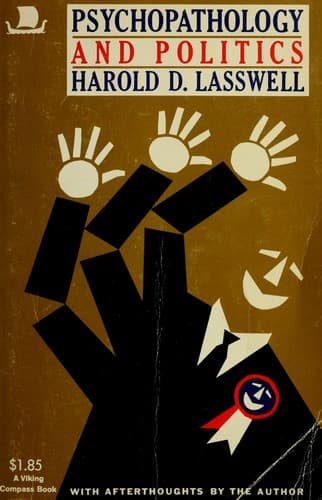
Psychopathology and politicsLasswell, Harold D. (Harold Dwight)
Science
Psychopathology and politics
Lasswell, Harold D. (Harold Dwight)
Personality and politics; Political science; Psychoanalysis; Psychology, Pathological
When the tumultuous life of society is flayed into precedents and
tanned into principles, the resulting abstractions suffer a strange
fate. They are grouped and regrouped until the resulting mosaic may
constitute a logical and aesthetic whole which has long ceased to bear
any valid relation to the original reality. Concepts are constantly
in danger of losing their reference to definite events. Notions like
liberty and authority require a new birth of meaning after they
have followed the tempting path of abstraction but a little way. If
conceptions are to serve and not to master the mind, their terms of
reference must intermittently undergo the most rigorous scrutiny.
The use of “institutional” categories in describing political life is
indispensable, but the publicists who employ them have little to say
about the “personal” influences which modify the expected behavior of
“legislatures,” “executives,” and “judiciaries.” It is no news that
“leadership” is an important variable in predicting the course of
events, but the standard treatises on politics have next to nothing to
offer about the traits of various kinds of agitators and organizers,
and nothing to say about the kinds of experiences out of which these
differences arise.
This limitation holds for the books about the theory of the state
and of politics which are written by Englishmen like Sidgwick and
Laski, Americans like Garner and W. W. Willoughby, and Europeans like
Jellinek, Schmidt, Kjellén, and Kelsen. No doubt these men possess
or have possessed a living sense of political realities. Of Sidgwick
it is related that he was wonderfully adept in entertaining his
circle for hours with incisive comments and amusing anecdotes about
public men. But of this “humanity” of politics there is little to
be found in what he wrote. Political biography has been relied upon
chiefly to convey a sense of the unpredictable in human affairs, and
to adorn an after-dinner tale. At its best, political biography has
contributed to an understanding of the factors which differentiate one
human personality from another. But it is no secret that the literary
biography or autobiography omits or distorts much of the intimate
history of the individual, and that many of the facts which modern
investigators have found to be important are numbered among the missing.
Where is it possible to secure a supply of life-histories in which
the usual conventionalities are ignored, and which are taken by
specialists in the sociological, psychological, and somatic influences
which play upon the individual? There exist in modern society sizeable
collections of such material which have hitherto been accorded slight
attention by students of social science. I refer to the case histories
of those individuals who have been ill, and especially those who have
been cared for in hospitals and sanitariums.[1]
Public-domain text, read in full here on John Shaqi.
Reviews
Reviews
No reviews yet
Be the first to share your thoughts on this work.
Join the Discussion
Join the discussion
Sign in to leave a comment or review.
Sign InorCreate an account