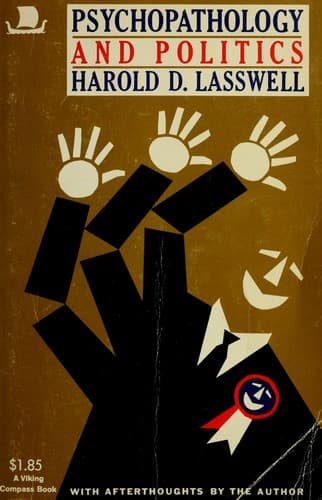
Psychopathology and politicsLasswell, Harold D. (Harold Dwight)
Science
Psychopathology and politics
Lasswell, Harold D. (Harold Dwight)
Personality and politics; Political science; Psychoanalysis; Psychology, Pathological
The types which we have just been considering show more than a
cross-sectional picture of the adult personality. They have made the
transition from itemizing the instantaneous pictures to the selection
of features of the immediate picture which show how the type has come
to be. They are thus more than co-relational types; they have made
some progress toward developmental types. When Giese found the group
of political personalities of humble origin and persistent organizing
and agitating activity, he postulated a common dynamic of development,
a homogeneous functional disposition toward this sort of thing. Moore
wanted to extricate the formative influence of temperamental reactive
sets, and the other investigators have likewise sought to ascertain
developmental factors in the production of the adult picture of traits
and interests.
Almost every nuclear and co-relational type carries developmental
implications. The terms which are used to characterize motives
have dynamic, genetic, formative coronas of meaning which, vaguely
though they may be sketched, are emphatically present. When Michels
says that a “Catonian strength of conviction” is one mark of the
political leader, it is implied that if one pushed his inquiry into
the adolescence, childhood, and even infancy of the individual that
this ruling characteristic would be visible. Of course, Michels
does not himself develop these implications; it is doubtful if he
has tried to find the early analogues of the trait which he called
“Cantonian strength of conviction” on the adult level. But the dynamic
penumbra of the term can lead empirical investigators to scrutinize
the behavior of children from a new point of view. Many of the terms
which are used to describe adult traits are no doubt unpredictable
from the less differentiated traits of infancy, childhood, and youth.
But the growth of full-blown developmental types requires the sifting
and refinement of terms until they are adequate to the description
of sequences of growth. Developmental types will describe a set
of terminal, adult reactions, and relate them to those critical
experiences in the antecedent life of the individual which dispose
him to set up such a mode of dealing with the world. Developmental
types will not only include the subjective account of the history of
the personality but will embrace the objective factors which were
co-operating to produce the patterns described.
The notion of a developmental type may be illustrated by examining
the place which is assigned to the political man in the chief modern
characterological systems. Hans Apfelbach has used five dimensions for
the description of characters. Each one is described as a gamut between
two polar opposites, and a sixth pair of polar opposites is introduced
into the system. The scheme is indicated in Table II.
Public-domain text, read in full here on John Shaqi.
Reviews
Reviews
No reviews yet
Be the first to share your thoughts on this work.
Join the Discussion
Join the discussion
Sign in to leave a comment or review.
Sign InorCreate an account