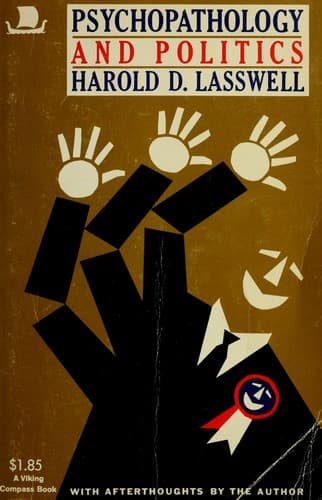
Psychopathology and politicsLasswell, Harold D. (Harold Dwight)
Science
Psychopathology and politics
Lasswell, Harold D. (Harold Dwight)
Personality and politics; Political science; Psychoanalysis; Psychology, Pathological
Freud was assailed at a vital spot and rallied to defend himself in
_Totem and Taboo_. He scored a point over Jung, who had relied on saga
material, by drawing heavily on the ethnological summaries of Frazer in
the _Golden Bough_ to justify the universality of the Oedipus complex.
This was Freud’s first contribution to systematic social theory, and
will come up for consideration in that connection. From the standpoint
of personality theory, perhaps the most valuable passages are those
which describe the infant’s overvaluation of thought--the “omnipotence
of thought,” as it was phrased by a patient.
Some years later Jung, now on his own for some time, devised his
classification of personality types and vastly increased popular and
technical interest in the subject. This in turn has stimulated the
group around Freud to develop a formal psychoanalytic characterology.
In this task they were assisted by some early communications of Freud,
wherein he took note of some of the character types met with in his
practice. This literature will be referred to in connection with the
case histories which are to be discussed immediately.
The other schisms between Freud and his pupils (involving Stekel and
Rank) have been less significant for personality theory thus far,
although Rank’s sociological interests may germinate now that he is
away from the immediate presence of the master.
Freud, who had obstinately clung to the phraseology of sex, rejecting
every proposal for an overmastering set of terms which would carry less
restricted connotations, executed a brilliant maneuver in 1926 and
proposed to regard human activity as manifestations of two principles,
the life and the death instincts. Life consists in accumulation and the
release of tension; and, generalizing this phenomenon, we have the life
and death drives.[29]
Suppose we put aside further exposition of the analytical personality
theories, and in the light of these conceptions set up a general
formula which describes the developmental history of the political man.
The most general formula would employ three terms. The first component,
_p_, stands for the private motives of the individual as they are
nurtured and organized in relation to the family constellation and the
early self. We shall have occasion to see that primitive psychological
structures continue to function within the personality long after the
epochs of infancy and childhood have been chronologically left behind.
The prominence of hate in politics suggests that we may find that the
most important private motive is a repressed and powerful hatred of
authority, a hatred which has come to partial expression and repression
in relation to the father, at least in patrilineal society, where the
male combines the function of biological progenitor and sociological
father.
Public-domain text, read in full here on John Shaqi.
Reviews
Reviews
No reviews yet
Be the first to share your thoughts on this work.
Join the Discussion
Join the discussion
Sign in to leave a comment or review.
Sign InorCreate an account