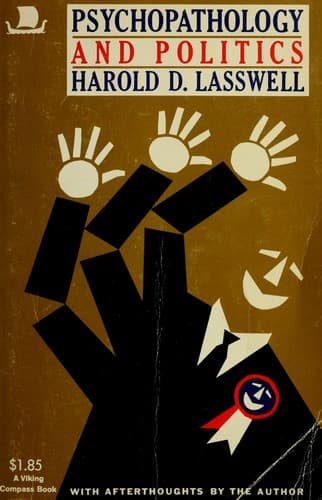
Psychopathology and politicsLasswell, Harold D. (Harold Dwight)
Science
Psychopathology and politics
Lasswell, Harold D. (Harold Dwight)
Personality and politics; Political science; Psychoanalysis; Psychology, Pathological
Before following out the full implications of this struggle of A’s
to repress his sexuality, we will take up another topic of major
and not unrelated importance. I refer to A’s ambivalence toward his
father. A was not conscious of the full force of his hatred and
his love for his father, but his personality history is full of
evidence of the formative influence of these bipolar attitudes. In
the course of his competition with his older brother, A accepted
abstinence from genital indulgence as the price of holding paternal
preference. Now psychoanalytic findings are unanimous in showing that
genital indulgence is not given up without a continuous struggle,
and that recurring waves of sexuality break against the barrier of
the introjected prohibition, and reanimate hostile impulses against
the sanctioning authority. It is of the utmost importance for A’s
development that he fought to bar from consciousness any hostile
thought directed against his father, and that he succeeded in
repressing his father-hatred very deeply. He was able to identify
himself with the father, and to copy many of the paternal standards and
attributes. The strength of these identifications is indicated by the
tenacity with which A held to certain paternal patterns. Although his
much-touted uncle had been a famous writer and professor, A remained a
preacher, even when tempted by a flattering offer to leave his first
humble parish for the faculty of a great university. He cherished the
paternal prejudice against money-making and money-makers. His boyhood
home was where some wealthy people spent their summers, and A’s
father would speak contemptuously of “the fashionables” who loitered
ostentatiously past the house. This was an additional determiner of A’s
subsequent devotion to the welfare of the poor, which manifested itself
in financial sacrifice and socialist agitation. A was very susceptible
to old men, and idealized not only his early teachers, but a venerable
pacifist who approved of his wartime conduct.
The negative side of A’s attitude toward authority came out in the
choice of the abstract (remote) objects upon which to vent his hatred.
The hostility which was denied conscious recognition and direct
indulgence against the actual father was displaced against substitute
symbols, such as the dogma which required the acceptance of the
Scriptures by faith, of the capitalistic system, and of the militarists.
Public-domain text, read in full here on John Shaqi.
Reviews
Reviews
No reviews yet
Be the first to share your thoughts on this work.
Elsewhere in the archive
Join the Discussion
Join the discussion
Sign in to leave a comment or review.
Sign InorCreate an account