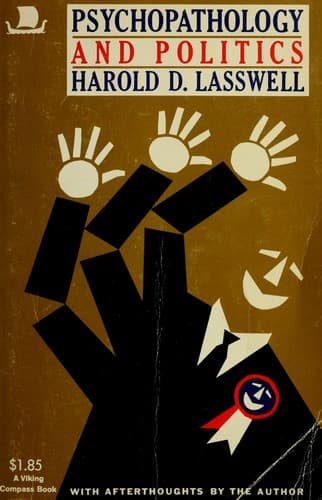
Psychopathology and politicsLasswell, Harold D. (Harold Dwight)
Science
Psychopathology and politics
Lasswell, Harold D. (Harold Dwight)
Personality and politics; Political science; Psychoanalysis; Psychology, Pathological
When A was introduced to a stranger, he was genial, talkative, and
anxious to impress. When he was aware of opposition in his environment,
he overreacted at once, hurling a vast repertory of jibes and flouts
and sneers at the offender. This gives a clue to an important element
in his makeup which will come out very distinctly in subsequent cases,
namely, a strong latent homosexual trend. When the individual is not
able to achieve full heterosexual adjustment, the sexual libido tends
to work itself out in more primitive ways, and one of the phases of
emotional development is the homosexual epoch. Earlier, however, than
the adolescent homosexual period is the phase connected with the
suppression of auto-erotic activities. The child characteristically
uses its nutritional object (nurse-mother) for the sake of stimulating
his own erogenous zones as much as possible. This “incestuous” drive
is curbed, and the child is denied the pleasure of promiscuously
fingering others, and of manually stimulating his own genitalia.
Though the nurse or mother, who is the target of the desires of the
child, also administers the prohibitions, the sanction which lurks most
prominently in the background is the strength of the father. Reduced
to its ultimate expression, this sanction is the threat of depriving
the child of his much-valued organs unless he observes the “hands off”
prohibition. The “normal” development is for the hostile protest at
authoritarian interference to subside, and for the child to copy the
idealized father. The repression of hostilities and the identification
with the father do not take place instantly. Identification is not
achieved without a phase in which the child plays a femininely passive
rôle toward the father, and this is the passively homosexual reaction
which may for one reason or another be unusually strong. A’s fantasies
of his father’s beautiful skin are common screen fantasies for more
primitive drives.
A’s tendency to overreact to the stranger who is merely polite,
and to interpret the stranger’s interest as a “personal” one, is
characteristic of the one in whom this passive “winning” rôle is of
some importance. He tries to create an overpersonal relationship
in those somewhat formal situations where ordinary conversational
requirements are such as to force conventional compliments.
Public-domain text, read in full here on John Shaqi.
Reviews
Reviews
No reviews yet
Be the first to share your thoughts on this work.
Elsewhere in the archive
Join the Discussion
Join the discussion
Sign in to leave a comment or review.
Sign InorCreate an account