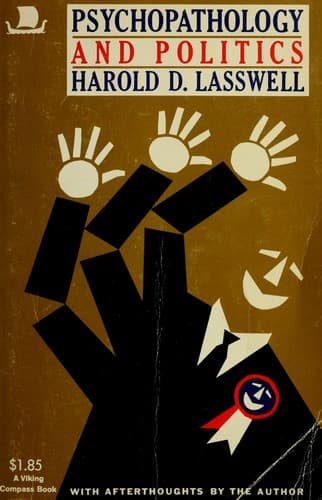
Psychopathology and politicsLasswell, Harold D. (Harold Dwight)
Science
Psychopathology and politics
Lasswell, Harold D. (Harold Dwight)
Personality and politics; Political science; Psychoanalysis; Psychology, Pathological
The overreactive hostility toward those who merely differ from him is
partially motivated by the desire to punish those who have rejected
the affection which he all too quickly volunteers. This wound to his
narcissism demands that wounds shall be inflicted on the offending
objects. Now it is commonly observed that repressed drives are likely
to secure partial gratification in the very activities which are in
part a protection against them. Sneers and jibes would at first seem
to free him from those who arouse and reject him, but this is not
the whole result. A exceeded the bounds of convention and became
recklessly provocative. His wild assaults and defiances tended to
provoke the social environment into attacking him, and thus to gratify
two powerful unconscious drives. He wanted to be forced into a passive,
feminine, victimized rôle, and to inflict upon himself the punishment
which he deserved for excessive hatred of others. Thus A felt quite
happy, escaping moods of depression, as long as he was indulging his
hostility against conspicuous conventional authorities in society, and
as long as he was suffering from society’s retaliatory measures. His
romantic idea of starving to death as a gesture of sanity in a war-mad
world is indicative of his pleasure in the “martyr rôle.”
He could not endure “inharmonious” people, and built up a “soft” and
overindulgent group around him. He had a small group of admirers who
turned to him for advice and who looked up to his superior wisdom
and moral courage. Nothing pained him more than the slightest jar in
personal relations. This disparity between his demands for gentleness
in the primary group, and his genius for creating a disturbance in a
secondary group, suggests the tension produced within his personality
by the struggle with the feminine component. He was careful to keep
away from close-working subordination to a powerful personality. He
stayed in environments where his authority was unchallenged. In the
church he was both a financial pillar and the pastor, and among the
socialists he was sustained by the halo of moral and cultural prestige.
It is noteworthy that though A was venomous when publicly opposed,
he was capable of a wooing and persuasive strain which he could
effectively use in his proselyting work. His humor was of the
mock-modesty variety, and relieved the moral earnestness of his
discourses. A showed much tenacity and skill in following people whom
he once loved and respected, and in attempting to convert them to a
community of views with him. He displayed a strong impulse to enter
into and to cultivate personal interchanges by correspondence.
Public-domain text, read in full here on John Shaqi.
Reviews
Reviews
No reviews yet
Be the first to share your thoughts on this work.
Elsewhere in the archive
Join the Discussion
Join the discussion
Sign in to leave a comment or review.
Sign InorCreate an account