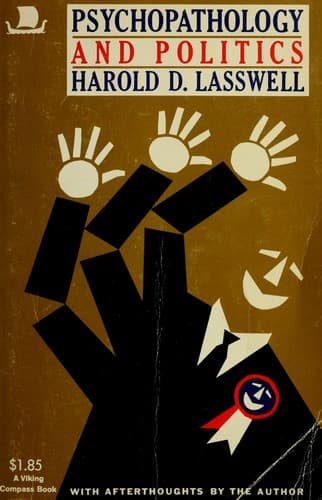
Psychopathology and politicsLasswell, Harold D. (Harold Dwight)
Science
Psychopathology and politics
Lasswell, Harold D. (Harold Dwight)
Personality and politics; Political science; Psychoanalysis; Psychology, Pathological
A’s intensity of manner betrayed the magnitude of the neurotic
conflicts within his own personality. This intensity is not alone
due to the insecurity arising from the failure to exterminate his
own conscious awareness of sex, nor to his sense of sin for erotic
impulses, nor to his fears of impotence, nor to the reaction organized
when he was competing with his brother for the attention of the father.
His sexual inhibitions removed from him one of the most dependable
means of disposing of the tensions which arise from the miscellaneous
frustrations met with in the course of daily life.[34]
We have traced A’s demand for widespread emotional response to his
difficulties of personal adjustment, especially in the field of early
sexual development. We have followed through the displacement of the
drives, which were originally organized with reference to the family
circle, on to remote social objects, resulting in the espousal of
ideals of social change. We have seen that A’s particular technique for
arousing emotional response was denunciatory oratory, and that such a
technique expressed important underlying drives of his personality.
Since A happened to be a socialist, it is natural to compare him
with the socialist thinkers studied by Werner Sombart in _Der
proletarische Sozialismus_. There is no doubt that A is numbered among
the “artificial” rather than the “natural” men, since his relation to
reality is less direct than with the “natural” type. But it cannot be
said that social criticism was as deeply motivated in his life as among
the men mentioned by Sombart. He expressed himself not only in radical
agitation but in conservative, moralistic agitation. His career was
not wrecked at any particular point in his history, and he possessed
no mania for destruction, although showing much resentment against his
family, and indulging in an active fantasy life. He was fundamentally
an agitator, and secondarily a social radical.
CHAPTER VII
POLITICAL AGITATORS--_Continued_
B is an agitator who uses his pen instead of his tongue. He has
achieved eminence in newspaper work, beginning as a news editor and
editorial writer. At twenty, when he held his first newspaper job, B
led a fight against the red-light district of the city, exposing the
pimps, panderers, and prostitutes in sensational style. He has always
responded quickly to the appeal of the underdog and revealed injustices
wherever he found them, and he won great popularity among minority
racial and national groups whose claims he championed before the
American public. It is noteworthy that B has never been converted to
“isms” and responds to the call of specific abuses. No one who knows B
has ever questioned his sincerity, for the news value of his campaigns
is often much less than the personal risks incurred.
Public-domain text, read in full here on John Shaqi.
Reviews
Reviews
No reviews yet
Be the first to share your thoughts on this work.
Elsewhere in the archive
Join the Discussion
Join the discussion
Sign in to leave a comment or review.
Sign InorCreate an account