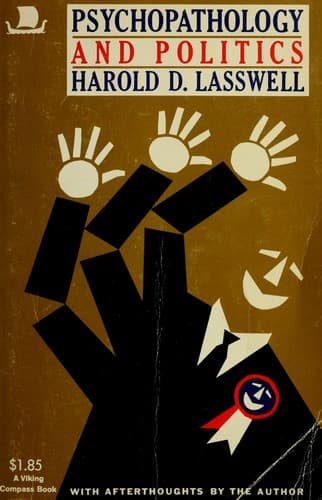
Psychopathology and politicsLasswell, Harold D. (Harold Dwight)
Science
Psychopathology and politics
Lasswell, Harold D. (Harold Dwight)
Personality and politics; Political science; Psychoanalysis; Psychology, Pathological
B has a high reputation for absolute truthfulness and reliability,
often carrying his scruples to what his fellow-newspapermen think are
unwarranted extremes. On one occasion, he threw up an excellent job on
a very well-known newspaper on a point of honor. The paper had divulged
the source of a story which he had received in confidence, and which
he communicated to the editor in confidence. Later he was made the
editor of an important newspaper. For five months he produced brilliant
results, when a misunderstanding arose with the proprietor over another
point of honor. In a despondent moment he resigned, but the proprietor
refused to let him leave, offering a substantial raise. He let himself
be persuaded to go back, but refused to accept the raise. Before long,
new points of honor arose, and he broke away for good. His passion for
justice made him a favorite with his staff; and his quiet good sense
and studiousness made him a name among older men and intellectuals.
Some of his reforming campaigns were very thinly veiled displacements
of his own private motives. At the age of fourteen he was seduced by
a colored woman, and he reacted to this experience with fright and
disgust. He left a school which he attended after a series of boyish
escapades which culminated in an argument over missing laundry. The
laundryman was a negro. It was on his first newspaper job that he led
the fight to clean up a red-light district, featuring the fact that
both colored and white prostitutes were available.
B was one of the numerous family of a Civil War veteran on the
Confederate side. His father carried himself like a soldier and
expected his children to act like soldiers under all circumstances. He
was spare, thin, and active, and his temper was short. He was boss in
the house, ordering his wife about a great deal, and demanding implicit
obedience from the children.
The mother of B was eleven years younger than her husband. She had
ten children in quick succession, and she spoiled them, and was
much beloved. She did all the cooking, washing, and ironing for the
household, and slaved to allow the children to obtain an education.
Everybody but her husband thought she worked too hard. She was herself
eager for learning, but had no opportunity to continue her studies
after marriage. Although poor, she was proud, and never asked alms or
assistance of any kind. Though “obstinate as a mule,” she was timid
and shrinking in ordinary relations. Her routine was only broken by
occasional headaches.
Public-domain text, read in full here on John Shaqi.
Reviews
Reviews
No reviews yet
Be the first to share your thoughts on this work.
Elsewhere in the archive
Join the Discussion
Join the discussion
Sign in to leave a comment or review.
Sign InorCreate an account