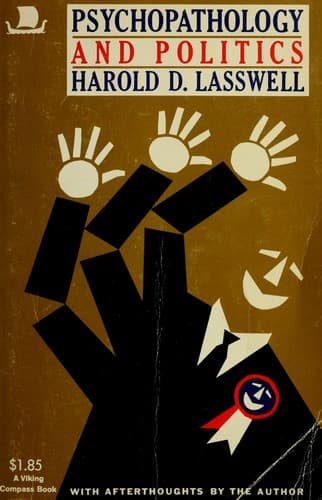
Psychopathology and politicsLasswell, Harold D. (Harold Dwight)
Science
Psychopathology and politics
Lasswell, Harold D. (Harold Dwight)
Personality and politics; Political science; Psychoanalysis; Psychology, Pathological
All during his high-school days he had occasional sex intercourse, but
every episode was marred by some disagreeable features. While there
were such experiences with girls of low social standing, he had many
friendships with girls of good social position whom he idealized as
above sexuality. He attended a private school which was patronized
almost exclusively by children from very wealthy families, and H, who
was handsome, well dressed, quick, and agreeable, found his friends
among them. He was often in their homes and admired the signs of wealth
and culture. He became sensitive of the cultural limitations of his own
parents, and was afraid to entertain his school friends at home, but
fortunately from his point of view his father was willing to furnish
enough money to make it possible to hold up his end of the social
bargain at exclusive clubs and restaurants.
In college H continued to draw a sharp line between those who could
be petted, but who were too rich and refined to be approached for
intercourse, and those who could be petted, and who were poor enough to
be asked for intercourse. He continued to associate with a smart and
wealthy set, and finally concentrated his attention on the daughter of
a rich business man whom he wanted to marry. His left-handed affairs
continued at irregular intervals, and he felt remorseful when he had
the perversions performed on him.
Enough has been reported to convey an impression of H’s inner state.
His unsatisfied sexual curiosity had been whetted by his prudish
parents. His father defended his own ascendancy in the home by
ordering the boy about a great deal, and H responded to authority by a
system of reactions which became characteristic of him. He was tactful,
deferential, and acquiescent, qualified by inner resentment and rare
gestures of defiance. The father was not a friend but a barrier to be
circumvented, and the father’s hegemony was protected by the sense of
guilty inferiority which he had created in his son. Family differences,
such as arose when the father objected to housekeeping details, or when
the boy wanted more freedom to use the car, always showed the same
balance of forces--mother and son versus the father. The mother did not
defend herself by robust contradiction but by weak complaints. There
were only two instances in which the boy flared up enough to resist his
father openly.
Public-domain text, read in full here on John Shaqi.
Reviews
Reviews
No reviews yet
Be the first to share your thoughts on this work.
Elsewhere in the archive
Join the Discussion
Join the discussion
Sign in to leave a comment or review.
Sign InorCreate an account