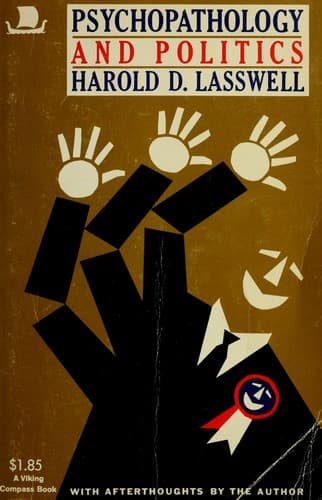
Psychopathology and politicsLasswell, Harold D. (Harold Dwight)
Science
Psychopathology and politics
Lasswell, Harold D. (Harold Dwight)
Personality and politics; Political science; Psychoanalysis; Psychology, Pathological
If H had been more successful in winning applause outside the family,
it is quite possible that his position would have been made much easier
inside it. His social charm brought him into the most influential
circles, and this gratified his parents, but his father was a man of
action who felt that while wealthy friends were an asset, his son
ought to show more positive achievements. Though he never nagged H,
the father’s sternness, suspiciousness and absence of praise made a
deep impression on the boy, and gave him a sense of insecurity and
inadequacy. Although H scored no great successes, he went along without
academic catastrophe until college. He was suspended at the end of
his Freshman year for poor work, but came back after six months,
during which he pretended to his father that he was still in school.
The suspension was partly due to the advice given to the dean by his
fraternity brothers, who had found him very hard to manage, and wanted
to “bring him to his senses.” H was having a fling, since he was away
from home for the first time, and away from the intimidating father.
Presently he steadied down enough to get along.
Reminiscences of his guilty sexual experiments, deeply charged with
guilt-feeling, were continually bobbing up to interfere with his
progress. Once he was assigned to debate in high-school public-speaking
class. His opponent proved to be the brother of the girl with whom
he had the notorious incident several years before. The brother was
a prominent school leader who had no doubt forgotten the affair, but
it continued to weigh on H. He always had felt uncomfortable in the
other boy’s presence, and on this occasion, being poorly prepared, the
situation became so unbearable that he fainted.
He began to study agriculture at college, but soon found that he
had made a mistake. His family owned a ranch which he often visited
during vacations, and very much enjoyed. Farming was an avocation of
his father, and H had the idea that ranching was a genteel occupation
without much work, and with much ordering of other people about.
He vaguely thought of himself as a country gentleman of cultivated
leisure. The war saved H from agriculture. He took up aviation, without
losing “credits,” partly because the snobbish mother of his favorite
girl was bowled over by the uniform, and partly because he thought it
would be better to go into the war, if he had to go, as an officer than
as a private. His father’s influence secured a deferred classification
for him in the draft, and H, though feeling quite small about it, said
to himself that it was better for people to die who were without his
own advantages and achievements.
Public-domain text, read in full here on John Shaqi.
Reviews
Reviews
No reviews yet
Be the first to share your thoughts on this work.
Elsewhere in the archive
Join the Discussion
Join the discussion
Sign in to leave a comment or review.
Sign InorCreate an account