Association of ideas; Memory; Paragrammatism; Psychoanalysis; Psychology, Pathological; Repression (Psychology)
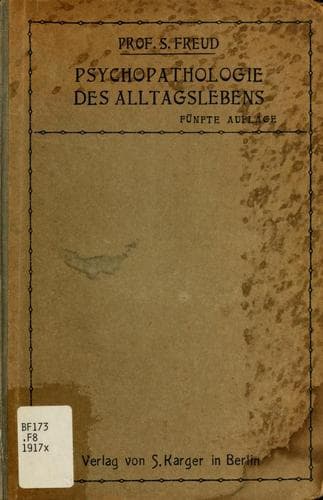
PSYCHOPATHOLOGY
OF EVERYDAY LIFE
BY
PROFESSOR DR. SIGMUND FREUD, LL.D.
AUTHORIZED ENGLISH EDITION, WITH
INTRODUCTION BY
A. A. BRILL, Ph.B., M.D.
_Chief of Clinic of Psychiatry Columbia University; Chief of the
Neurological Department, Bronx Hospital and Dispensary;
former Assistant Physician in the Central Islip State
Hospital, and in the Clinic of Psychiatry, Zurich_
NEW YORK
THE MACMILLAN COMPANY
1914
(_All rights reserved_)
INTRODUCTION
Professor Freud developed his system of psychoanalysis while studying
the so-called border-line cases of mental diseases, such as hysteria
and compulsion neurosis. By discarding the old methods of treatment
and strictly applying himself to a study of the patient’s life he
discovered that the hitherto puzzling symptoms had a definite meaning,
and that there was nothing arbitrary in any morbid manifestation.
Psychoanalysis always showed that they referred to some definite
problem or conflict of the person concerned. It was while tracing back
the abnormal to the normal state that Professor Freud found how faint
the line of demarcation was between the normal and neurotic person,
and that the psychopathologic mechanisms so glaringly observed in the
psychoneuroses and psychoses could usually be demonstrated in a lesser
degree in normal persons. This led to a study of the faulty actions
of everyday life and later to the publication of the _Psychopathology
of Everyday Life_, a book which passed through four editions in
Germany and is considered the author’s most popular work. With great
ingenuity and penetration the author throws much light on the complex
problems of human behaviour, and clearly demonstrates that the hitherto
considered impassable gap between normal and abnormal mental states is
more apparent than real.
This translation is made of the fourth German edition, and while the
original text was strictly followed, linguistic difficulties often made
it necessary to modify or substitute some of the author’s cases by
examples comprehensible to the English-speaking reader.
A. A. BRILL.
NEW YORK.
CONTENTS
CHAPTER PAGE
INTRODUCTION v
I. FORGETTING OF PROPER NAMES 3
II. FORGETTING OF FOREIGN WORDS 17
III. FORGETTING OF NAMES AND ORDER OF WORDS 29
IV. CHILDHOOD AND CONCEALING MEMORIES 57
V. MISTAKES IN SPEECH 71
VI. MISTAKES IN READING AND WRITING 117
VII. FORGETTING OF IMPRESSIONS AND RESOLUTIONS 135
VIII. ERRONEOUSLY CARRIED-OUT ACTIONS 177
IX. SYMPTOMATIC AND CHANCE ACTIONS 215
X. ERRORS 249
XI. COMBINED FAULTY ACTS 265
Public-domain text, read in full here on John Shaqi.
Reviews
Reviews
No reviews yet
Be the first to share your thoughts on this work.
Join the Discussion
Join the discussion
Sign in to leave a comment or review.
Sign InorCreate an account