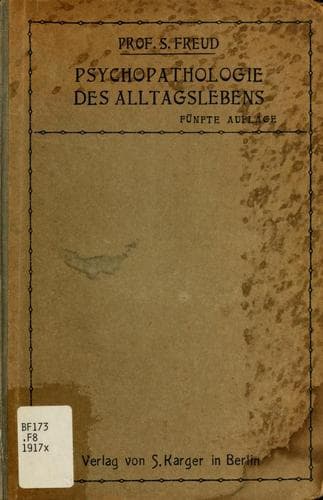
Association of ideas; Memory; Paragrammatism; Psychoanalysis; Psychology, Pathological; Repression (Psychology)
“The meaning of the symptomatic act now at last became clear. The
subject had placed his wooden stethoscope between him and his patients,
just as Sigurd had placed his sword (an equivalent symbol) between him
and the maiden he was not to touch. The act was a compromise-formation;
it served both to gratify in his imagination the repressed wish to
enter into nearer relations with an attractive patient (interposition
of phallus), and at the same time to remind him that this wish was not
to become a reality (interposition of sword). It was, so to speak, a
charm against yielding to temptation.
“I might add that the following passage from Lord Lytton’s _Richelieu_
made a great impression on the boy:--
‘_Beneath the rule of men entirely great
The pen is mightier than the sword_,’[57]
and that he became a prolific writer and uses an unusually large
fountain-pen. When I asked him what need he had of this pen, he replied
in a characteristic manner, ‘I have so much to express.’
“This analysis again reminds us of the profound views that are afforded
us in the psychic life through the ‘harmless’ and ‘senseless’ actions,
and how early in life the tendency to symbolization develops.”
I can also relate an experience from my psychotherapeutic practice in
which the hand, playing with a mass of bread-crumbs, gave evidence of
an eloquent declaration. My patient was a boy not yet thirteen years of
age, who had been very hysterical for two years. I finally took him for
psychoanalytic treatment, after a lengthy stay at a hydrotherapeutic
institution had proved futile. My supposition was that he must have
had sexual experiences, and that, corresponding to his age, he had
been troubled by sexual questions; but I was cautious about helping
him with explanations as I wished to test further my assumption. I was
therefore curious as to the manner in which the desired material would
evince itself in him.
One day it struck me that he was rolling something between the fingers
of his right hand; he would thrust it into his pocket and there
continue playing with it, then would draw it out again, and so on. I
did not ask what he had in his hand; but as he suddenly opened his hand
he showed it to me. It was bread-crumbs kneaded into a mass. At the
next session he again brought along a mass, and in the course of our
conversation, although his eyes were closed, modelled a figure with an
incredible rapidity which excited my interest. Without doubt it was a
manikin like the crudest prehistoric idols, with a head, two arms, two
legs, and an appendage between the legs which he drew out to a long
point.
Public-domain text, read in full here on John Shaqi.
Reviews
Reviews
No reviews yet
Be the first to share your thoughts on this work.
Elsewhere in the archive
Join the Discussion
Join the discussion
Sign in to leave a comment or review.
Sign InorCreate an account