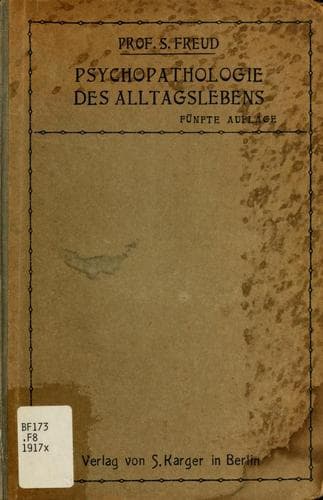
Association of ideas; Memory; Paragrammatism; Psychoanalysis; Psychology, Pathological; Repression (Psychology)
I once undertook to improve the marriage relations of a very
intelligent man, whose differences with his tenderly attached young
wife could surely be traced to real causes, but as he himself admitted
could not be altogether explained through them. He continually occupied
himself with the thought of a separation, which he repeatedly rejected
because he dearly loved his two small children. In spite of this he
always returned to that resolution and sought no means to make the
situation bearable to himself. Such an unsettlement of a conflict
served to prove to me that there were unconscious and repressed
motives which enforced the conflicting conscious thoughts, and in such
cases I always undertake to end the conflict by psychic analysis. One
day the man related to me a slight occurrence which had extremely
frightened him. He was sporting with the older child, by far his
favourite. He tossed it high in the air and repeated this tossing till
finally he thrust it so high that its head almost struck the massive
gas chandelier. Almost, but not quite, or say “just about!” Nothing
happened to the child except that it became dizzy from fright. The
father stood transfixed with the child in his arms, while the mother
merged into an hysterical attack. The particular facility of this
careless movement, with the violent reaction in the parents, suggested
to me to look upon this accident as a symbolic action which gave
expression to an evil intention toward the beloved child.
I could remove the contradiction of the actual tenderness of this
father for his child by referring the impulse to injure it to the
time when it was the only one, and so small that as yet the father
had no occasion for tender interest in it. Then it was easy to assume
that this man, so little pleased with his wife at that time, might
have thought: “If this small being for whom I have no regard whatever
should die, I would be free and could separate from my wife.” The wish
for the death of this much loved being must therefore have continued
unconsciously. From here it was easy to find the way to the unconscious
fixation of this wish.
There was indeed a powerful determinant in a memory from the patient’s
childhood: it referred to the death of a little brother, which the
mother laid to his father’s negligence, and which led to serious
quarrels with threats of separation between the parents. The continued
course of my patient’s life, as well as the therapeutic success
confirmed my analysis.
IX
SYMPTOMATIC AND CHANCE ACTIONS
Public-domain text, read in full here on John Shaqi.
Reviews
Reviews
No reviews yet
Be the first to share your thoughts on this work.
Elsewhere in the archive
Join the Discussion
Join the discussion
Sign in to leave a comment or review.
Sign InorCreate an account