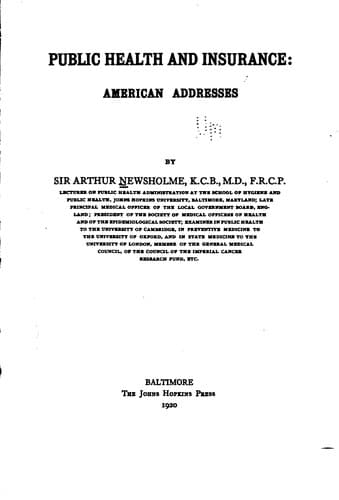
Public health and insurance: American addressesNewsholme, Arthur, Sir
History
Public health and insurance: American addresses
Newsholme, Arthur, Sir
Health insurance -- Great Britain; Public health; Public health -- Great Britain
I do not propose to touch on the important subjects of unemployment,
of under-employment, or of the relation between the size of family
and poverty, though the last named of these opens up an interesting
subject of discussion. (On this see page 164.) I shall confine my
remarks to the very obvious relation between poverty and sickness,
and to the neglect to act on our present knowledge, which if acted
on would in a short time lead to a great reduction of poverty in our
midst.
There is much truth in each of the statements that poverty is
responsible for much disease, that disease is responsible for the
greater part of the total poverty in our midst, and that poverty
begets poverty.
Poverty and disease are allied by the closest bonds, and nothing can
be simpler or more certain than the statement that the removal of
poverty would effect an enormous reduction of disease. The removal of
poverty must, therefore, be in itself an object always fascinating
to those whose study is the public health. The diseases which would
be reduced by this means, include not merely those which physicians
treat, but many moral diseases which persist because they are only
to be avoided by the poor through the exercise of discipline and
self-restraint far beyond what is practised by the average person
in classes not subject to poverty. The happiness of a community
being in itself a desirable object, a national asset, it is also not
irrelevant to consider that the removal of poverty involves enlarged
opportunities for enjoyment which, rightly directed, would be only
of less value than the removal of disease. It is not surprising,
therefore, that the first impulse of a student of the public
well-being, in which the public health is the most important factor,
is to attack disease by demanding the reduction of poverty, with its
more or less inevitable accompaniments of over-fatigue, privation,
overcrowding, and dirt. And it must be freely admitted that when
the most active public health administration, including adequate
medical aid for the sick, has attained its utmost efficiency, and has
in every respect done all that it can to reduce disease, there will
still remain a cruel residuum which can be attacked in no other way
than by the removal of poverty, or by the removal from poverty of the
elements of personal privation which affect the public health.
Public-domain text, read in full here on John Shaqi.
Reviews
Reviews
No reviews yet
Be the first to share your thoughts on this work.
Elsewhere in the archive
Join the Discussion
Join the discussion
Sign in to leave a comment or review.
Sign InorCreate an account