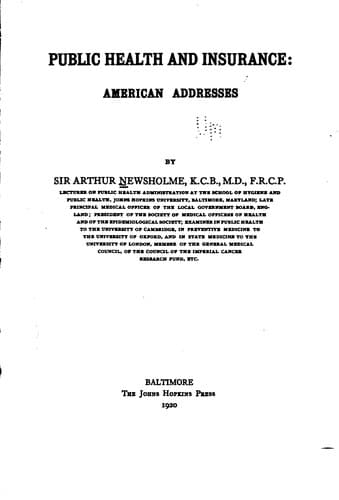
Public health and insurance: American addressesNewsholme, Arthur, Sir
History
Public health and insurance: American addresses
Newsholme, Arthur, Sir
Health insurance -- Great Britain; Public health; Public health -- Great Britain
The importance attached to poverty as a cause of illness and
mortality is illustrated in reports on local investigations,
displaying an inverse relationship in different communities between
family income and the rate of infant mortality, the reader being left
to infer, that increase of the lower incomes is the one method for
obviating excessive loss of infantile life. In suggesting this crude
generalization it is evident that poverty is being regarded as an
element, instead of as a highly complex phenomenon, which needs to be
further analysed into its constituent parts. The crude generalised
statement as to the relation between excessive mortality and poverty,
furthermore, fails to bring out three essential points, viz., that
infant mortality may be very low in communities in which poverty is
the rule; that it may be high in the absence of poverty; and that
where infant mortality is high, it can be greatly reduced without
change of economic conditions.
There should be an adequate family income for every family; and the
social conscience cannot be satisfied until this is realised. But,
in seeking for practical reform we must appreciate that a large
share of the disease and of the inefficiency of the individual and
family associated with poverty can be remedied otherwise than by
an increase of the family income. This is shown by national and
international experience. The death-toll on infant life is very much
lower in Norway and in Ireland—both relatively poor countries—than
in England. Poverty in these instances evidently has less weight
than the favorable factors of rural life and natural feeding. A like
discrepancy in experience of infant mortality is seen between the
experience of towns, and of wards in the same town, with approximate
equality as regards poverty. Similarly in England the infants of
miners with relatively high wages suffer a higher mortality (160
per 1,000 births in 1911) than the infants of textile operatives
(148) with relatively low wages; while the latter suffer more than
the infants of agricultural labourers (97). These instances at once
suggest that some conditions in town life play an important part
in causing excessive infant mortality; that in towns insanitary
conditions and habits of life are even more injurious than the
absence from home of the industrially employed mother; and that
the causation of infant mortality is complex, and its prevention
necessitates a multifarious attack on social and industrial evils,
the character of this attack necessarily varying in different
localities, in accordance with the incidence of these evils. That
the influence of urban life in causing excessive mortality can be
counteracted is shown by the varying mortality in different urban
communities, and in different parts of the same town.
Public-domain text, read in full here on John Shaqi.
Reviews
Reviews
No reviews yet
Be the first to share your thoughts on this work.
Elsewhere in the archive
Join the Discussion
Join the discussion
Sign in to leave a comment or review.
Sign InorCreate an account