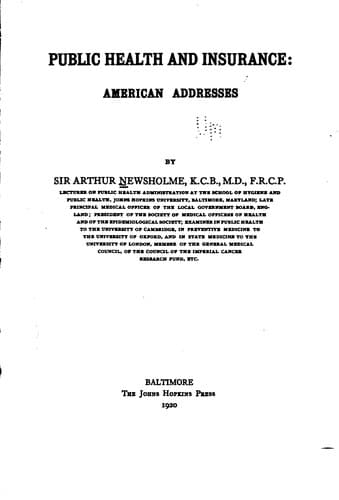
Public health and insurance: American addressesNewsholme, Arthur, Sir
History
Public health and insurance: American addresses
Newsholme, Arthur, Sir
Health insurance -- Great Britain; Public health; Public health -- Great Britain
The relief of poverty is at the best an inefficient and expensive
remedy. It is seldom adequate, and it has few preventive elements.
The prevention of poverty by prevention of the illness causing it,
and by early and satisfactory treatment of such illness as fails to
be prevented is the only efficient, as well as in the long run the
only economical plan of campaign. Money insurance against sickness
has its place as a means of alleviating the results of poverty.
But it is not an aid to its prevention; under any existing system
of insurance the money payment is insufficient and definitely
limited in duration. Although such relief is useful, it is totally
unsatisfactory when not linked up with a complete system of hygienic
measures, and when not associated with adequate medical treatment and
nursing. For the linking of treatment provided largely out of public
funds with insurance there is no justification, and it is contrary to
the public interest; and it is unfortunate that monetary insurance
has been provided in England for a section of the population under
these unsatisfactory conditions, thus diverting expenditure from the
public health services in which it was urgently needed, and in which
its use would at once have been fruitful in increased health and
happiness.
FOOTNOTES:
[16] An address to the Political Economy Club, Johns Hopkins
University, Jan. 19, 1920.
CHAPTER IX
THE CAUSATION OF TUBERCULOSIS AND THE MEASURES FOR ITS CONTROL IN
ENGLAND[17]
My task is to attempt to give a bird’s-eye view of “The Methods of
Controlling Tuberculosis in England,” and to revaluate, as far as
is practicable, in the light of many years’ study of the disease,
the relative value of the measures which historically have been
followed by the greatly reduced mortality from tuberculosis. The
subject teems with difficulties, and as you are aware there is no
unanimity of opinion when tuberculosis is thus considered. This is
the more surprising in view of our present accurate knowledge of the
pathology of disease caused by bovine and human tubercle bacilli, and
in view of the fairly general unanimity of opinion as to the methods
of control which are needed to secure still more rapid reduction
of the devastations of tuberculosis. This general opinion may, I
think, be summarised in the statement which I have made elsewhere,
that the removal or diminution of infection from each single case of
tuberculosis reduces correspondingly the prospect of further cases,
but that tuberculosis will not be completely controlled until every
tuberculous patient receives such care throughout the whole course of
his life, as will ensure his welfare and will obviate the likelihood
of his infecting others.
Public-domain text, read in full here on John Shaqi.
Reviews
Reviews
No reviews yet
Be the first to share your thoughts on this work.
Elsewhere in the archive
Join the Discussion
Join the discussion
Sign in to leave a comment or review.
Sign InorCreate an account