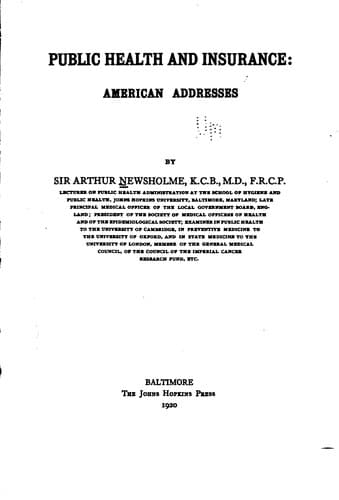
Public health and insurance: American addressesNewsholme, Arthur, Sir
History
Public health and insurance: American addresses
Newsholme, Arthur, Sir
Health insurance -- Great Britain; Public health; Public health -- Great Britain
It is noteworthy that the English death-rate from pulmonary
tuberculosis—which is responsible for 71 per cent. of the total
mortality from tuberculosis, and which is practically always due to
infection from a human source,—declined in males between 1871-75
and 1876-80 by 7.2 per cent.; in the next quinquennium by 9.8 per
cent.; between 1881-85 and 1886-90 by 8.3 per cent.; in the next
quinquennium by 9.5 per cent.; between 1896-1900 and 1901-05 by 7 per
cent.; and between 1901-06 and 1906-10 by 9.7 per cent. Evidently a
large share of the reduction of the death-rate from phthisis occurred
before it was generally regarded as an infectious disease, and before
sanatoria were in existence for its treatment. It should be added
that since the possibilities of infection have been realised and
the need for treatment of the disease has been appreciated, there
has in no part of the world, so far as I am aware, been an adequate
application of known methods of prevention and treatment.
We must look elsewhere, therefore, than to intentional measures
directed against tuberculosis for an explanation of its decline
during the period before Koch discovered the tubercle bacilli
and before the significance of this discovery was appreciated;
and attempt to appreciate the relative value of the factors of
decline operating before and since our outlook on the disease was
fundamentally changed.
Certain facts stand out beyond controversy, and on these
administrative control must necessarily be based.
_Basic Facts as to Tuberculosis_
1. Tuberculosis is a chronic infectious disease with a low degree of
infectivity. Circumstances favouring infection have a high degree of
importance; but tuberculosis does not develop in the absence of the
tubercle bacillus. No infection, no disease.
2. Tuberculosis may remain latent in the system for many years, and
there is strong reason for thinking that the infection of a large
proportion of early adult tuberculosis was acquired in childhood.
3. The two types of tubercle bacilli, bovine and human, are
stable both in character and in degree of virulence, and are not
interchangeable so far as can be shown by protracted experimentation.
The human type of bacillus is the chief source of infection of
mankind, though bovine infection is not negligible.
Out of 98 children between the age of 2 and 10 years who had died in
various hospitals from all causes unselected, 18 or 18.4 per cent.
were found to have been infected by tubercle bacilli of the bovine
type, and 81 or 81.6 per cent. by tubercle bacilli of the human
type. (Report on Investigations made in the Laboratory of the Local
Government Board, Annual Report of the Medical Officer of the Local
Government Board, 1913-14, p. lix.)
Public-domain text, read in full here on John Shaqi.
Reviews
Reviews
No reviews yet
Be the first to share your thoughts on this work.
Elsewhere in the archive
Join the Discussion
Join the discussion
Sign in to leave a comment or review.
Sign InorCreate an account