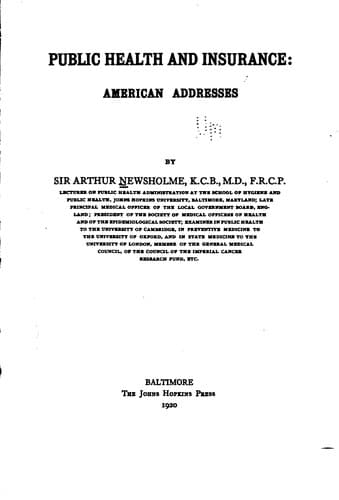
Public health and insurance: American addressesNewsholme, Arthur, Sir
History
Public health and insurance: American addresses
Newsholme, Arthur, Sir
Health insurance -- Great Britain; Public health; Public health -- Great Britain
I have seen no reason for revoking the conclusion expressed in 1908
in a lecture to the Washington International Congress on Tuberculosis
that historically the hospital treatment and coincident segregation
of patients suffering from pulmonary tuberculosis has been an
important and probably a dominant factor in producing the national
decline in the death-rate from tuberculosis in the countries in which
a decline has been experienced. This explanation fits in with our
knowledge of the disease, and with the analogous history of leprosy;
and it is supported by the fact that by complete segregation of
infected from non-infected cattle tuberculosis can be eliminated at
will from a herd of cattle. It is remarkable, as I have elsewhere
set out in much detail, that improved general health, increased
well-being, and sanitary education have operated in Great Britain,
Germany, Belgium, Denmark, and Massachusetts side by side with great
decrease in the death-rate from pulmonary tuberculosis; while up to
very recent years the same influences in France, Norway, and Ireland
have produced little or no decrease in the national death-rate from
tuberculosis. And similarly no constant relation can be shown between
the degree of sanitary and social well-being in different countries
and cities, and the amount of mortality imposed by tuberculosis. How
is it that in some countries a high degree of domestic overcrowding
is associated with a low and declining phthisis death-rate and
conversely that a persistently high phthisis death-rate may occur
with a less but still diminishing degree of overcrowding? The
explanation is contained, I maintain, in the following statement:
Public-domain text, read in full here on John Shaqi.
Reviews
Reviews
No reviews yet
Be the first to share your thoughts on this work.
Elsewhere in the archive
Join the Discussion
Join the discussion
Sign in to leave a comment or review.
Sign InorCreate an account