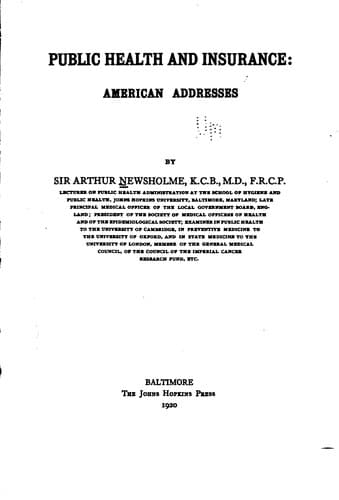
Public health and insurance: American addressesNewsholme, Arthur, Sir
History
Public health and insurance: American addresses
Newsholme, Arthur, Sir
Health insurance -- Great Britain; Public health; Public health -- Great Britain
(_c_) If the assumption of increasing racial immunity does not
consist well with all the facts, more perhaps can be said in favour
of the unproved hypothesis that a high proportion of the population
are from time to time temporarily immunized by small doses of
tubercle bacilli; and their resistance to larger doses of infection
thereby increased. Experimentally calves inoculated with small doses
of tubercle bacilli remain during the next year or two unaffected by
much larger doses of tubercle bacilli, unlike calves not submitted
to this treatment. Tubercle bacilli are somewhat widely distributed,
though they occur chiefly in the immediate environment of careless
consumptive patients; and it is conceivable that minimal doses of
bacilli may arouse the resistance of the cells and fluids of the body
and prepare them to resist successfully larger doses of infection.
This is consistent with the fact that while one in about ten deaths
from all causes is caused by tuberculosis, a majority of the total
population are shown by pathological evidence to have been at one
time or another infected by tuberculosis, and yet have either
never been ill, or have recovered, usually without the existence of
tuberculosis being detected or even suspected. Obviously this is
satisfactory evidence that mankind is relatively resistant to the
infection of tuberculosis.
The fact just mentioned naturally leads to the question: what
determines the result when tubercle bacilli invade the human subject?
Assuming fairly uniform virulence of tubercle bacilli, the result for
an infected person depends on two factors: the dosage of infection,
and the resistance of the cells and fluids of the invaded person;
and evidently increase in the dosage of infection and lowering of
personal resistance may have identical effect in determining serious
disease. Of the importance of the already mentioned factors which
lower personal resistance to disease,—often also at the same time
increasing infection,—there can be no doubt.
It is impossible in most instances to set out separately
circumstances increasing infection from circumstances lowering
resistance. During the last three or four decades there has been
improvement in respect of the factors lowering resistance to attack,
but there has been simultaneously a great decline in opportunities
for infection on a massive scale, as a result of habits of greater
cleanliness, especially in regard to spitting, of diminished
overcrowding of population, and of increased treatment and the
incidental segregation of advanced cases of disease in hospital beds.
_Hospital Treatment of Consumptives_
Public-domain text, read in full here on John Shaqi.
Reviews
Reviews
No reviews yet
Be the first to share your thoughts on this work.
Elsewhere in the archive
Join the Discussion
Join the discussion
Sign in to leave a comment or review.
Sign InorCreate an account