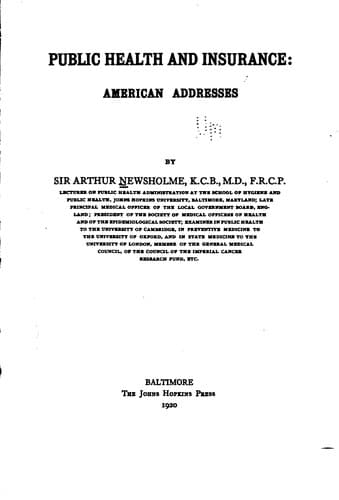
Public health and insurance: American addressesNewsholme, Arthur, Sir
History
Public health and insurance: American addresses
Newsholme, Arthur, Sir
Health insurance -- Great Britain; Public health; Public health -- Great Britain
Some writers have failed to visualize the fact that the segregation
of a minority of the total cases of pulmonary tuberculosis for a
portion of their illness can have had a marked influence on the
prevalence of this disease. They appear to be judging tuberculosis
by the same measure as they would apply to smallpox, which in an
unprotected community spreads rapidly if a few cases are overlooked.
The case of tuberculosis, like that of leprosy, is governed by the
considerations that both these diseases as a rule require intimate
and protracted contact for their spread, and that in both diseases
there may be prolonged latency before active disease develops.
A hypothetical illustration may serve to elucidate the order of
magnitude of the influence exercised by institutional segregation.
Let us assume—as is probably the case in England—that one-fifth of
the cases of pulmonary tuberculosis are treated during one-third of
a year institutionally under conditions in which they will not be
liable to spread infection. Let us assume further that each of these
cases has an infectious lifetime of three years. Thus one-fifth of
the cases are deprived of their power to spread infection during
one-ninth of their period of “open” disease. It being assumed that
personal infection causes pulmonary tuberculosis and that segregation
is efficient, segregation to the extent indicated above should secure
a reduction in the death-rate from pulmonary tuberculosis of 100/(5 ×
9) approximately 2 per cent.
In actual fact the decline in the English death-rate from pulmonary
tuberculosis since 1871 has been at a rate slightly under 2 per cent.
per annum.
_Koch’s Endorsement of Segregation View_
An extract from an article written by Robert Koch shortly before his
death may be permitted (Epidemiologie der Tuberkulose Zeitschr. für
Hyg. und Infektious Krankheiten. 4. XVII, 1910).
I am entirely in agreement with Newsholme that the allocation of
consumptives to institutions for the sick, as freely as possible
and for as long as possible, is the most active means of avoiding
infection and the consequent spread of phthisis.
In my experience, too, phthisis has shown the most marked decline
in those places where comprehensive measures have been taken for
bringing consumptives into hospitals, and the converse has been the
case where the converse conditions prevail. It is indeed obvious
that in no other way can the danger of infection, which a phthisical
patient constitutes, be so effectively removed as by isolation in
hospital. Strong support of this method is afforded by leprosy,
where good results in attacking the disease have been obtained by
following the same principle.
In addition to this factor there is a second, which also plays a
very important part, viz., housing.
Public-domain text, read in full here on John Shaqi.
Reviews
Reviews
No reviews yet
Be the first to share your thoughts on this work.
Elsewhere in the archive
Join the Discussion
Join the discussion
Sign in to leave a comment or review.
Sign InorCreate an account