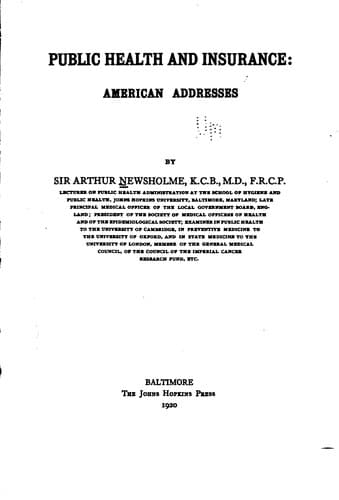
Public health and insurance: American addressesNewsholme, Arthur, Sir
History
Public health and insurance: American addresses
Newsholme, Arthur, Sir
Health insurance -- Great Britain; Public health; Public health -- Great Britain
A hypothesis explanatory of a given phenomenon should be consistent
with all the associated facts. We have seen that the hypothesis
that segregation of consumptives is an important factor in the
reduction of the death-rate from pulmonary tuberculosis agrees (1)
with our knowledge of the tubercle bacillus, and (2) with veterinary
and agricultural experience; also (3) that,—although exact data
are unobtainable,—the degree of segregation when ascertainable
is consistent with the degree of decline in the death-rate; (4)
it is important to note also that this hypothesis is consistent
with the otherwise anomalous facts that although the proportion of
the population subjected to urban conditions of life has steadily
increased, and the number of persons per inhabited room remains much
greater in towns than in country districts, the death-rate from
pulmonary tuberculosis in England has declined as much in them as in
country districts; and that notwithstanding the greater overcrowding
in towns, the urban is rapidly falling to the level of the rural
death-rate from this disease. The town dweller’s better and more
frequent treatment in hospitals is an important factor in overcoming
the handicap of urban conditions of life, including overcrowding and
preponderance of indoor and dusty occupations.
It is desirable to supplement the above statement by some remarks on
_Improved Housing as a Means of Reducing Tuberculosis_
Not infrequently the thoughtless remark is made that given
improved housing sanatoria and hospitals for consumptives would be
unnecessary. The frequent occurrence of tuberculosis in well-to-do
families shows the absurdity of this statement. It is true that
tuberculosis is more prevalent among the poor living in small
tenements that among the well-to-do; but there is no consistent
proportion between the degree of overcrowding in different districts
or towns and the death-rate from tuberculosis. Improved housing
and institutional treatment for tuberculosis cannot properly be
regarded as alternatives. They are necessary complements to each
other, and there must be increased expenditure in both directions,
if tuberculosis is to be more rapidly reduced in amount. There are
in fact two housing problems—for the healthy, and for the sick. The
most rapid method of improving housing for the healthy is to remove
the sick, and especially the tuberculous sick to a hospital. This is
being done year by year to an increasing extent. In England and Wales
in 1870, 8.3 per cent., and in 1912 21.6 per cent. of all deaths
from all causes occurred in public institutions. It is difficult to
exaggerate the practical relief implied in these figures in respect
of satisfactory housing, especially in its functional aspect. Apart
altogether from the tuberculosis problem much of the decline in
the general death-rate must be attributed to the skilled treatment
which a large proportion of the total population have received in our
hospitals of various types.
Public-domain text, read in full here on John Shaqi.
Reviews
Reviews
No reviews yet
Be the first to share your thoughts on this work.
Elsewhere in the archive
Join the Discussion
Join the discussion
Sign in to leave a comment or review.
Sign InorCreate an account