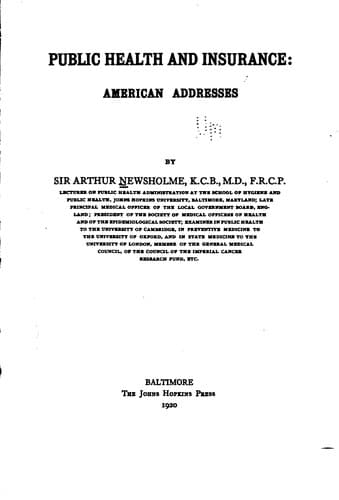
Public health and insurance: American addressesNewsholme, Arthur, Sir
History
Public health and insurance: American addresses
Newsholme, Arthur, Sir
Health insurance -- Great Britain; Public health; Public health -- Great Britain
2. Under present conditions of medical practice, early diagnosis
of tuberculosis often fails to be secured, even when the patient
places himself under medical care. It is to the private practitioner
that most patients resort, and the early recognition and treatment
of disease depends primarily (_a_) on his skill, (_b_) on his not
being so overworked as to be unable to devote adequate time to the
examination of each patient coming under his care, and (_c_) on
his willingness to refer doubtful cases for consultation with the
official tuberculosis officer of each area. These officials have
only existed during the last few years; their work was partially in
abeyance during the four and a half years of war; and apart from
this, they have not always succeeded in persuading the private
practitioner that their coöperation is to be welcomed and that they
are not agents for depriving him of his private patients. This
assumed antagonism between private and public medical practice is one
of the most serious difficulties in securing more rapid progress in
anti-tuberculosis work.
3. For nearly every sanitary area gratuitous facilities are now
provided for the examination of sputum for tubercle bacilli, and yet
in many areas there is grave neglect to utilize this provision, and
patients with chronic phthisis may be treated during long months
or even years for “winter cough,” “bronchitis,” etc., without
adequate physical examination of sputum. The diagnosis of pulmonary
tuberculosis ought, it is true, to be made before tubercle bacilli
are found in the sputum, and failure to recognize the disease prior
to this implies that the disease has already become serious; but
in fact a very large proportion of consumptive patients for many
months have tubercle bacilli in their sputum, before the diagnosis of
tuberculosis is made.
4. When, as in some areas, the medical officer of health or the
tuberculosis officer takes little, if any, useful action after
notifications have been received, the practitioner has an excuse
for not notifying subsequent cases. He can argue with some cogency
that notification has no value _per se_; its utility depends on the
action which follows on notification. Unless useful action follows
on notification, default in notification has little practical
importance.
_Public Health Action Following Notification_
Under the English Tuberculosis Regulations the medical officer
of health or an officer of the local authority acting under his
instructions is required to make such inquiries and take such steps
as may be necessary or desirable for investigating the source of
infection, for preventing the spread of infection, and for removing
conditions favourable to infection. The action required includes
_inter alia_
1. Attention to the personal hygiene of the patient, including
instruction in the necessary precautions as to coughing and
expectoration.
2. Any assistance needed to ensure for the patient
Public-domain text, read in full here on John Shaqi.
Reviews
Reviews
No reviews yet
Be the first to share your thoughts on this work.
Elsewhere in the archive
Join the Discussion
Join the discussion
Sign in to leave a comment or review.
Sign InorCreate an account