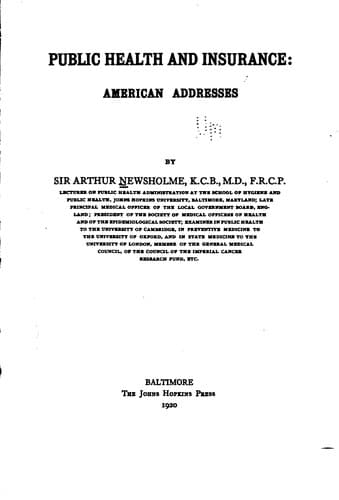
Public health and insurance: American addressesNewsholme, Arthur, Sir
History
Public health and insurance: American addresses
Newsholme, Arthur, Sir
Health insurance -- Great Britain; Public health; Public health -- Great Britain
Prior to the general enforcement of notification of tuberculosis
in England excellent local work had been done in a relatively
small number of areas in direct efforts to control the spread of
tuberculosis, in addition to the previous general measures, such as
improved sanitation, better housing, more satisfactory nutrition, and
especially the hospital treatment of a large proportion of advanced
and acute cases of tuberculosis. The Report of the last Royal
Commission on Tuberculosis appeared in 1911; and although precautions
against human infection by tuberculous cows’ milk are still very
incomplete, the pasteurisation or boiling of milk is more generally
practised than in the past.
Local Authorities prior to 1911 had power to build sanatoria or
otherwise provide institutional accommodations for the treatment
of tuberculous patients; relatively little had been done in most
areas. In 1911 the Finance Act provided a sum of £1,116,000 for the
erection of sanatoria in England and Wales, and this, with money
provided by local rates, has led to rapid increase in accommodation
for the residential institutional treatment of tuberculosis. In
England in 1911 local authorities, other than poor-law authorities,
had about 1300 beds for the institutional treatment of tuberculosis,
while there were 4,200 beds in private sanatoria and voluntary
institutions. In 1917 the total available beds numbered 12,441, of
which about one-half had been provided by local authorities.
In 1911 the National Insurance Act was passed and came into operation
in July, 1912. This provided a special “Sanatorium Benefit.”
The Departmental Committee appointed to make recommendations as to
detailed direct measures against tuberculosis, reported in April,
1912, that any scheme which is to form the basis of an attempt to
deal with the problem of tuberculosis should be available for the
whole community, and that its organization should be undertaken by
the large local authorities (the councils of counties and county
boroughs). These recommendations were at once adopted by the
Government, which undertook to provide out of the national exchequer
one-half of the net cost of approved local schemes for the general
treatment of tuberculosis. Local authorities were invited at once
to prepare schemes for institutional treatment, residential and
non-residential, domiciliary treatment remaining in the hands of
private practitioners, of poor-law doctors, and of doctors engaged in
the contract work under the National Insurance Act (“panel doctors”).
The last named are in medical charge of the large mass of the
wage-earners of the community, comprising roughly one-third of the
total population, in so far as their treatment at home is within the
power of a practitioner of average competence. The schemes proposed
for each area comprised,
Public-domain text, read in full here on John Shaqi.
Reviews
Reviews
No reviews yet
Be the first to share your thoughts on this work.
Elsewhere in the archive
Join the Discussion
Join the discussion
Sign in to leave a comment or review.
Sign InorCreate an account