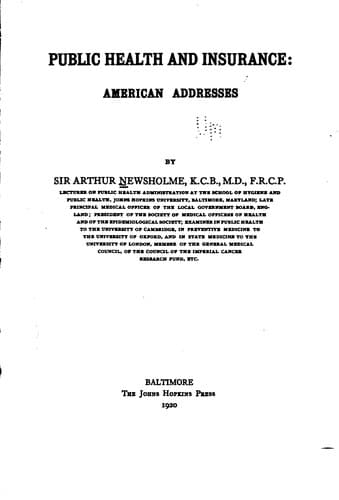
Public health and insurance: American addressesNewsholme, Arthur, Sir
History
Public health and insurance: American addresses
Newsholme, Arthur, Sir
Health insurance -- Great Britain; Public health; Public health -- Great Britain
1. The appointment of a tuberculosis officer, usually a whole-time
official, who was required to have had special experience in the
diagnosis and treatment of tuberculosis, and who as a rule was an
officer in the public-health department under the administrative
supervision of the medical officer of health, but independent in his
clinical work;
2. The establishment of tuberculosis dispensaries, at which patients
were treated, consultations as to doubtful cases held, and contacts
examined;
3. The provision of beds in residential institutions for curable and
for acute and advanced cases;
4. The organization of arrangements for “following up” and
“after-care.”
During 1912 and 1913 advance was made in these directions. In 1911
there were 25-30 tuberculosis dispensaries: in 1917 their number
had increased to 371. In 1914 the onset of the Great War prevented
further development of tuberculosis work and seriously crippled and
reduced the efficiency of work already initiated; and this increased
as the military demand for medical officers and institutions became
greater. It may be stated generally that in only a relatively
small number of areas have fairly complete arrangements for the
institutional treatment of tuberculosis come into operation; and
that even in these areas the arrangements have been at work for only
a limited period. It is evident, therefore, as already pointed out,
that no argument as to the utility of these arrangements can be based
on the facts that the death-rate from tuberculosis has not declined
with increased rapidity in recent years, and that women during the
war, especially at the working years of life have experienced an
increased death-rate from this disease.
_Tuberculosis Dispensaries_
The tuberculosis officer is the essential element in the dispensary;
and in rural districts he may be said to carry the dispensary under
his hat. The dispensary if properly organized should serve as the
centre of official anti-tuberculosis measures. The medical officer of
health receives the notifications of recognised cases whether they
are attending the dispensary or not; and it simplifies administration
if the home supervision of all tuberculous patients notified to
the medical officer of health, and not only of dispensary patients,
is placed under the supervision of the tuberculosis officer. At
the dispensary itself the tuberculosis officer examines patients,
makes records of their condition, and of all facts bearing on their
welfare, and recommends the special form of continued treatment
adapted to their condition. This may be domiciliary, or given at the
dispensary, or in a sanatorium, or in a hospital. A dispensary which
does not supervise and treat a large proportion of the total notified
cases, including especially patients before and after they have
received treatment in a residential institution, is not fulfilling
its possibilities of utility.
Public-domain text, read in full here on John Shaqi.
Reviews
Reviews
No reviews yet
Be the first to share your thoughts on this work.
Elsewhere in the archive
Join the Discussion
Join the discussion
Sign in to leave a comment or review.
Sign InorCreate an account