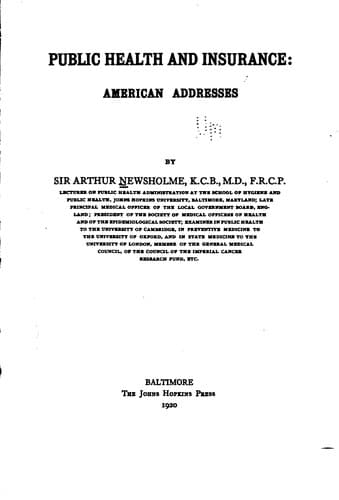
Public health and insurance: American addressesNewsholme, Arthur, Sir
History
Public health and insurance: American addresses
Newsholme, Arthur, Sir
Health insurance -- Great Britain; Public health; Public health -- Great Britain
This is true, although certain problems respecting tuberculosis
still need elucidation, e.g., as to improved methods of treating the
diseases, and of increasing individual immunity during exposure to
protracted infection.
2. Domestic protection is at once practicable against infected cows’
milk; and control of this source of infection at its source is also
practicable.
3. Of the circumstances favouring the development of pulmonary
tuberculosis industrial dust and domestic overcrowding are the most
potent. More detailed and systematic supervision of factories and
workshops is needed, followed by general adoption of remedies, which
would increase industrial efficiency as well as reduce tuberculosis.
4. Tuberculosis is especially a “bedroom infection.” But improvement
in housing is a dual problem, and it is a blunder to assume that
improved housing, so long as the healthy and tuberculous sick
continue to be housed together, will produce a rapid decline in the
prevalence of tuberculosis. Hospital provision for the sick is as
necessary as improved general housing.
FOOTNOTES:
[17] The substance of two lectures at the Summer School on
Tuberculosis, Trudeau Sanatorium, Saranac, N. Y., July, 1919.
CHAPTER X
CHILD WELFARE WORK IN ENGLAND[18]
The subject of child welfare, in its chief developments, cannot be
separated from that of Public Health, of which it forms a constituent
part, though I do not ignore the fact that child welfare is largely
dependent also on the extent to which child labor is exploited, and
to which expectant and nursing mothers,—as also other mothers whose
extra-domestic employment or whose employment for gain is within the
home itself,—involves neglect of young children.
Improvement in child welfare has occurred as the sanitary and social
progress of the country has advanced. Whereas in the decade 1871-80,
when money began to be spent more freely on elementary sanitary
reform, the expectation of life or mean after-lifetime at birth of
males was 41.4 years and of females was 44.6 years; in the years
1910-12 these had increased to 51.5 and 55.4 years respectively. The
greater part of the saving of life which this addition of ten years
to the average duration of life was the result of reduced mortality
in children under five years of age.
Public-domain text, read in full here on John Shaqi.
Reviews
Reviews
No reviews yet
Be the first to share your thoughts on this work.
Elsewhere in the archive
Join the Discussion
Join the discussion
Sign in to leave a comment or review.
Sign InorCreate an account