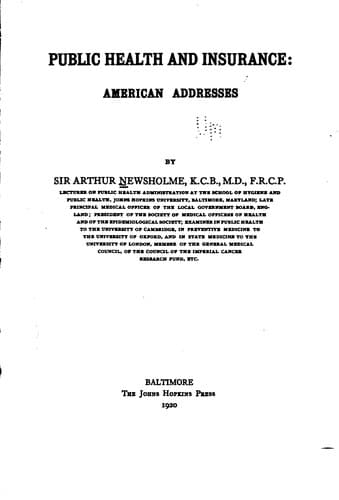
Public health and insurance: American addressesNewsholme, Arthur, Sir
History
Public health and insurance: American addresses
Newsholme, Arthur, Sir
Health insurance -- Great Britain; Public health; Public health -- Great Britain
The first direct steps towards the reduction of infant mortality
were directed against epidemic or summer diarrhœa. Medical officers
of health have always been required in their annual reports to
summarize the vital statistics in their districts; and since 1905
a more detailed statement of infant mortality during each part of
infancy has been required. Annually, therefore, as well as when they
received the weekly returns of deaths from the local registrars,
there was forced upon their attention the fact that deaths of infants
under one year of age formed a high proportion of total deaths at all
ages (12.9 per cent. in 1917), and that of these infantile deaths a
large proportion were caused by diarrhœa, the number varying with
the temperature and the deficiency of rainfall in the summer months.
In 1912, a year of relatively small mortality from diarrhœa, this
disease caused 8.1 per cent. of all deaths under one year of age.
For many years past it has been customary for medical officers of
health to issue warnings as to summer diarrhœa, to arrange for the
distribution of leaflets of advice concerning the disease, and to
urge the necessity of more thorough cleanliness both municipal and
domestic during the summer months. Even before the early notification
of births became obligatory, in many areas the addresses of infants
were obtained from the registrars of births and special visits were
made to the mothers of infants during the months of June and July
and especially to the mothers of those infants who were known to be
artificially fed.
The reports of medical officers of health of many of the large
towns from 1890 onwards show that much valuable work was being
accomplished, and the way was being prepared for more general
measures against infant mortality.
The importance of municipal sanitation in aiding the elimination
of diarrhœal mortality is illustrated in the experience of many
towns, and strikingly by the comparative experience of Leicester
and Nottingham. The chief difference between the sanitary condition
of the two towns was that in Nottingham in 1909 pail closets still
served more than half the houses, while Leicester had abandoned this
system entirely, substituting water-closets. Between 1889-93 and 1909
the diarrhœal mortality in Leicester had declined 52 per cent.; in
Nottingham it had only declined 4 per cent.
Public-domain text, read in full here on John Shaqi.
Reviews
Reviews
No reviews yet
Be the first to share your thoughts on this work.
Elsewhere in the archive
Join the Discussion
Join the discussion
Sign in to leave a comment or review.
Sign InorCreate an account