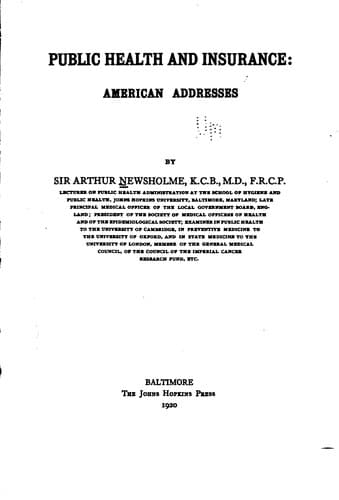
Public health and insurance: American addressesNewsholme, Arthur, Sir
History
Public health and insurance: American addresses
Newsholme, Arthur, Sir
Health insurance -- Great Britain; Public health; Public health -- Great Britain
Prior to the stage at which early notifications of births was
obtained, the medical officer of health was dependent for his
information on the registration of births, for which an interval of
six weeks after birth was permitted before it became compulsory.
During this interval a large proportion of the total mortality of
infancy had occurred,—approximately one-fifth of the total deaths
in the first year after birth occur in the first week and one-third
in the first month after birth,—and the possibility of successfully
influencing the mother to continue breast-feeding had gone. The
action of the town of Huddersfield in 1906 in obtaining Parliamentary
power to secure the compulsory notification of births within
thirty-six hours of birth represented a rapid growth of opinion
based on experience in that and other towns to the effect that in
the absence of early information of birth the necessary sanitary
precautions and counsel as to personal hygiene could not be given
with the greatest prospect of success. This local pioneer work
doubtless facilitated the passing of the Notification of Births Act
in 1907.
Much important work followed the notification of births. Home visits
to the mother were regarded and continue to be regarded as the most
important part of this work; but there also grew up rapidly the
present system of Infant Consultations and similar organizations.
The Notification of Births (Extension) Act, 1915, not only made
the enforcement of this act universal, but it also empowered each
local authority administering the Act to exercise any powers which a
sanitary authority possesses under the Public Health Acts “for the
purpose of the care of expectant mothers, nursing mothers, and young
children.” In drawing the attention of Local Authorities to the terms
of the Act the Local Government Board, as well as earlier in the war,
deprecated false economy during the war. They said:
At a time like the present the urgent need for taking all possible
steps to secure the health of mothers and children and to diminish
ante-natal and post-natal infant mortality is obvious, and the Board
are confident that they can rely upon local authorities making the
fullest use of the powers conferred on them.
The Board in the same circular laid stress on “the importance of
linking up this work with the other medical and sanitary services
provided by local authorities under the Public Health and other Acts.”
The passing of this Act has been followed by an increasingly rapid
development of Maternity and Child Welfare work, and the Maternity
and Child Welfare Act passed in August, 1918, made it obligatory on
each Council exercising powers under the Act to appoint a Maternity
and Child Welfare Committee, which must include at least two women,
and may include persons specially qualified by training or experience
in subjects relating to health and maternity who are not members of
the Council.
Public-domain text, read in full here on John Shaqi.
Reviews
Reviews
No reviews yet
Be the first to share your thoughts on this work.
Elsewhere in the archive
Join the Discussion
Join the discussion
Sign in to leave a comment or review.
Sign InorCreate an account