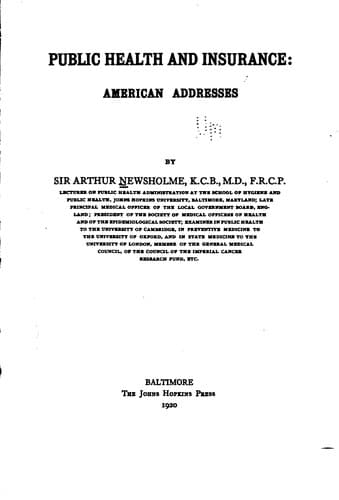
Public health and insurance: American addressesNewsholme, Arthur, Sir
History
Public health and insurance: American addresses
Newsholme, Arthur, Sir
Health insurance -- Great Britain; Public health; Public health -- Great Britain
_Voluntary Workers._—Much of the success so far achieved in improving
the health conditions of infancy and childhood has been secured by
coöperation between voluntary and official health visitors. Excellent
work has been done by local and other societies, particularly during
the last ten years, in educating public opinion and in direct
assistance to mothers and their infants. It is essential that such
voluntary work should have a nucleus of highly trained and well-paid
workers; but given this condition, a large amount of good work can be
accomplished by voluntary aid.
The main work has been that of the _health visitor_. The details of
this work, the conditions of qualification of workers, the number of
visits which it is desirable to make, the character of the advice
intended to be given at these visits are set out in an official
memorandum of the Medical Officer of the Local Government Board and
it is unnecessary to repeat this information in these pages.
A similar remark applies to the next most important development of
work, the institution of _Maternity and Child Welfare Centres_. The
conditions of work of these institutions are set out in the same
document.
_Training and Provision of Midwives_
The provision of additional trained midwives is a pressing problem.
The increased cost of living, longer training required, and the
rapid development of less laborious and more lucrative occupations,
have made it difficult to secure women to train as midwives, or to
continue to practise in this capacity after qualification. In many
industrial areas the older _bonâ fide_ midwife is preferred, although
it is the almost universal experience that the trained midwife more
quickly detects conditions endangering the life of the mother or
infant, and sends for medical help. In order to encourage further
the supply of practising midwives, the government gives grants
for increased remuneration to midwives newly appointed by local
authorities, sufficient to recoup them in the course of a few years’
service for the cost of their training.
At a recent date, of some 30,543 trained midwives on the Roll, only
6,754 were returned as being in actual practice as such.
In order to make midwives available for all women needing them, the
Board repays to local authorities and voluntary associations half the
cost of the provision of a midwife for necessitous women. During the
Great War a woman might receive assistance in her confinement from
several central sources; for in addition to the above
(1) If she was the wife of an insured person, or if she herself is
insured, she received under the conditions of the National (Health)
Insurance Act 30s. in cash, or if she is insured and the wife of an
insured person 60s. in cash.
(2) If she was the wife of a soldier or sailor and not entitled to
maternity benefit she received from 10s. per week up to £2 from the
Local Pensions Committee.
Public-domain text, read in full here on John Shaqi.
Reviews
Reviews
No reviews yet
Be the first to share your thoughts on this work.
Elsewhere in the archive
Join the Discussion
Join the discussion
Sign in to leave a comment or review.
Sign InorCreate an account