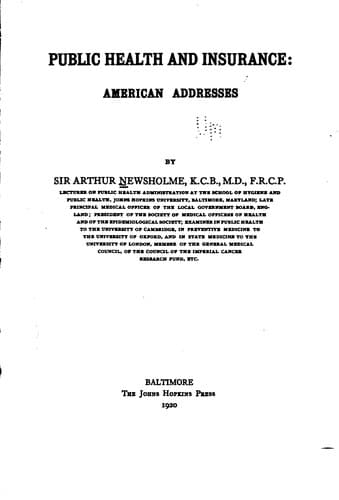
Public health and insurance: American addressesNewsholme, Arthur, Sir
History
Public health and insurance: American addresses
Newsholme, Arthur, Sir
Health insurance -- Great Britain; Public health; Public health -- Great Britain
(3) If she was a munition worker she might be aided under a scheme
provided under the Ministry of Munitions.
(4) She also might obtain priority for the supply of milk, or obtain
free milk or milk at cost price under the Local Committee Board
Food Control Order, No. 1, 1918, empowering local authorities to
supply milk and food and an extra ration under the Food Controller’s
Order. In addition, after confinement she had available the ration
apportioned to the infant and its allowance of milk under the
priority scheme.
There was evidently need for simplification and unification of effort
in the above cases.
In many instances maternity nursing is required. The midwife may have
too many patients to be able to give this during the ten days in
which she is in charge of the patient; and even when she carries out
her duty in this respect in accordance with the Rules of the Central
Midwives Board additional help is required in the feeding and care of
the mother and infant, and in the care of the household. Often also
nursing is required for both mother and infant for a considerable
period beyond the ten days. For these persons the government gives
grants for maternity nursing and for “home helps.”
Even when all the above requirements are or can be fulfilled, there
remain a large number of cases of pregnant women, and especially
of unmarried women, who cannot be satisfactorily confined at home,
either because of their social or sanitary circumstances, or
because abnormal or complicated childbirth is expected. For such
cases hospital provision is needed. This is one of the most urgent
requirements of the present time.
Under present conditions, institutional lying-in provision is
chiefly voluntary in character; and the government has advised
local authorities to contract for its use, rather than wait for the
erection of special hospitals. In other instances houses are being
taken and adapted as maternity homes.
_Ante-natal Work_
The progress made in the organisation of ante-natal work is slow for
reasons which are fairly obvious. There has been difficulty under war
conditions in securing assistance from doctors and midwives. There
is the well-known difficulty as to notification of pregnancy, which
the government has not encouraged, except when the definite consent
of the mother has been previously obtained. The facilities for
help provided at the Centre have in some areas attracted patients;
and health visitors and midwives have done much in other areas to
persuade mothers of the advisability of safeguarding themselves
against possible complications, as well as of securing adequate
preparation for the lying-in period.
Public-domain text, read in full here on John Shaqi.
Reviews
Reviews
No reviews yet
Be the first to share your thoughts on this work.
Elsewhere in the archive
Join the Discussion
Join the discussion
Sign in to leave a comment or review.
Sign InorCreate an account