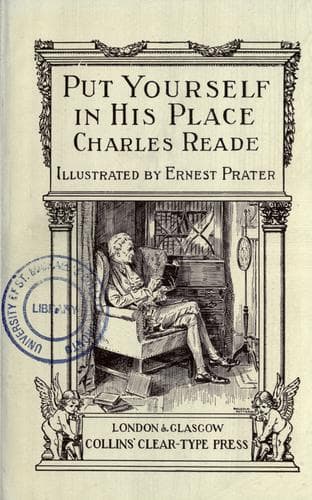
English fiction -- 19th century; Labor unions -- Fiction
The windows were curtained with snow, that increased the general gloom,
though some of the layers shone ghostly white and crystalline, in the
light of the forge, and of two little grates he had set in a monument.
Two heaps of snow lay in the center aisle, just under two open places
in the roof, and, on these, flakes as big as a pennypiece kept falling
through the air, and glittered like diamonds as they passed through the
weird light of the white coals.
Oh! it was an appalling place, that night; youth and life seemed
intruders. Henry found it more than he could bear. He took a couple of
candles, placed them in bottles, and carried them to the western window,
and there lighted them. This one window was protected by the remains of
iron-work outside, and the whole figure of one female saint in colored
glass survived.
This expedient broke the devilish blackness, and the saint shone out
glorious.
The horrid spell thus broken in some degree, Henry plied his hammer, and
made the church ring, and the flaming metal fly.
But by-and-by, as often happened to him now, a drowsiness overcame him
at the wrong time. In vain he battled against it. It conquered him even
as he worked; and, at last, he leaned with his arms against the handle
of the bellows, and dozed as he stood.
He had a dream of that kind which we call a vision, because the dream
seems to come to the dreamer where he is.
He dreamed he was there at his forge, and a soft voice called to him.
He turned, and lo! between him and the western window stood six female
figures, all dressed in beautiful dresses, but of another age, and of
many colors, yet transparent; and their faces fair, but white as snow:
and the ladies courtesied to him, with a certain respectful majesty
beyond description: and, somehow, by their faces, and their way of
courtesying to him, he knew they were women of his own race, and
themselves aware of the relationship.
Then several more such figures came rustling softly through the wall
from the churchyard, and others rose from the vaults and took their
places quietly, till there was an avenue of dead beauties; and they
stood in an ascending line up to the west window. Some stood on the
ground, some on the air; that made no difference to them.
Another moment, and then a figure more lovely than them all shone in the
window, at the end of that vista of fair white faces.
It was Grace Carden. She smiled on him and said, “I am going where I
can love you. There the world will not divide us. Follow me: follow;
follow!”
Then she melted away; then all melted: and he awoke with a loud cry that
echoed through the edifice, now dark and cold as the grave; and a great
white owl went whirling, and with his wings made the only air that
stirred.
The fire was out, and the place a grave. Yet, cold as it was, the
dreamer was bathed in perspiration, so clear had been that unearthly
vision, so ghostly was now that flitting owl.
Public-domain text, read in full here on John Shaqi.
Reviews
Reviews
No reviews yet
Be the first to share your thoughts on this work.
Elsewhere in the archive
Join the Discussion
Join the discussion
Sign in to leave a comment or review.
Sign InorCreate an account