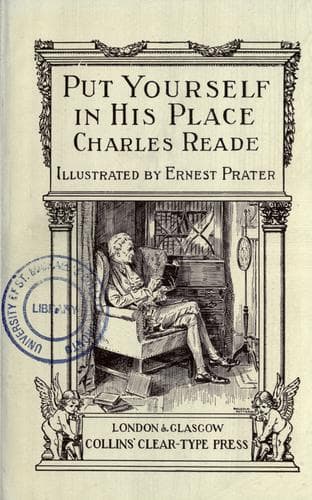
English fiction -- 19th century; Labor unions -- Fiction
The days were very short now, and Henry spent two-thirds of his time
in Cairnhope Church. The joyous stimulus of his labor was gone but the
habit remained, and carried him on in a sort of leaden way. Sometimes he
wondered at himself for the hardships he underwent merely to make money,
since money had no longer the same charm for him; but a good workman is
a patient, enduring creature, and self-indulgence, our habit, is after
all, his exception. Henry worked heavily on, with his sore, sad heart,
as many a workman had done before him. Unfortunately his sleep began
to be broken a good deal. I am not quite clear whether it was the
after-clap of the explosion, or the prolonged agitation of his young
heart, but at this time, instead of the profound sleep that generally
rewards the sons of toil, he had fitful slumbers, and used to dream
strange dreams, in that old church, so full of gaunt sights and strange
sounds. And, generally speaking, however these dreams began, the figure
of Grace Carden would steal in ere he awoke. His senses, being only half
asleep, colored his dreams; he heard her light footstep in the pattering
rain, and her sweet voice in the musical moan of the desolate building;
desolate as his heart when he awoke, and behold it was a dream.
The day after Christmas-day began brightly, but was dark and lowering
toward afternoon. Mrs. Little advised Henry to stay at home. But
he shook his head. “How could I get through the night? Work is my
salvation. But for my forge, I should perhaps end like--” he was going
to say “my poor father.” But he had the sense to stop.
Unable to keep him at home, the tender mother got his saddlebags, and
filled his flask with brandy, and packed up a huge piece of Yorkshire
pie, and even stuffed in a plaid shawl. And she strained her anxious
eyes after him as he rode off.
When he got among the hills, he found it was snowing there very hard;
and then, somehow, notwithstanding all the speed he made, it was nearly
dark when he got on the moor, and the tracks he used to go by, over the
dangerous ground, were effaced.
He went a snail's pace, and at last dismounted, and groped his way. He
got more than one fall in the snow, and thought himself very fortunate,
when, at last, something black towered before him, and it was the old
church.
The scene was truly dismal: the church was already overburdened with
snow, and still the huge flakes fell fast and silently, and the little
mountain stream, now swollen to a broad and foaming torrent, went
roaring by, behind the churchyard wall.
Henry shivered, and made for the shelter.
The horse, to whom this church was merely a well-ventilated stable, went
in and clattered up the aisle, saddle-bags and all.
Henry locked the door inside, and soon blew the coals to a white heat.
The bellows seemed to pant unnaturally loud, all was so deadly still.
Public-domain text, read in full here on John Shaqi.
Reviews
Reviews
No reviews yet
Be the first to share your thoughts on this work.
Elsewhere in the archive
Join the Discussion
Join the discussion
Sign in to leave a comment or review.
Sign InorCreate an account