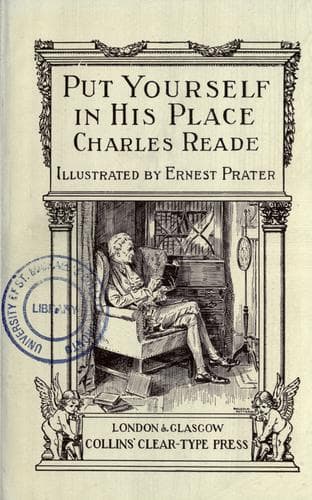
English fiction -- 19th century; Labor unions -- Fiction
Grace Carden saw him coming, and opened the door to him herself, red as
scarlet, and her eyes swimming. She scarcely made an effort to contain
herself by this time, and when she got him into the drawing-room all
to herself, she cried, for joy and tenderness, on his shoulder; and, it
cost him a gulp or two, I can tell you: and they sat hand in hand,
and were never tired of gazing at each other; and the hours flew by
unheeded. All their trouble was as though it had never been. Love
brightened the present, the future, and even the past. He did not tell
Grace one word of what he had suffered from Vicaria--I thank thee,
doctor, for teaching me that word--it had lost all interest to him. Love
and happiness had annihilated its true character--like the afternoon sun
gilding a far-off pig-sty. He did mention the subject, however, but it
was in these terms: “And, dearest, I'm hard at work inventing, and I
patent all my inventions; so I hope to satisfy your father before two
years.”
And Grace said, “Yes; but don't overwork your poor brain and worry
yourself. I am yours in heart, and that is something, I hope. I know it
is to me; I wouldn't change with any wife in Christendom.”
CHAPTER XXIX.
At the end of two months the situation of affairs was as follows:
Grace Carden received a visit every week from Henry, and met him now and
then at other houses: she recovered her health and spirits, and,
being of a patient sex, was quite contented, and even happy. Frederick
Coventry visited her often, and she received his visits quite
graciously, now that the man she loved was no longer driven from her.
She even pitied him, and was kind to him and had misgivings that she
had used him ill. This feeling he fostered, by a tender, dejected, and
inoffensive manner. Boiling with rage inside, this consummate actor
had the art to feign resignation; whereas, in reality, he was secretly
watching for an opportunity to injure his rival. But no such opportunity
came.
Little, in humble imitation of his sovereign, had employed a go-between
to employ a go-between, to deal with the State go-betweens, and
deputy-go-betweens, that hampered the purchase--the word “grant” is out
of place, bleeding is no boon--of a patent from the crown, and by
this means he had done, in sixty days, what a true inventor will do in
twenty-four hours, whenever the various metallic ages shall be succeeded
by the age of reason; he had secured his two saw-grinding inventions, by
patent, in Great Britain, the Canadas, and the United States of America.
He had another invention perfected; it was for forging axes and
hatchets by machinery: but this he did not patent: he hoped to find his
remuneration in the prior use of it for a few months. Mere priority is
sometimes a great advantage in this class of invention, and there are no
fees to pay for it nor deputy-lieutenant-vice-go-betweens' antechambers
for genius to cool its heels and heart in.
Public-domain text, read in full here on John Shaqi.
Reviews
Reviews
No reviews yet
Be the first to share your thoughts on this work.
Elsewhere in the archive
Join the Discussion
Join the discussion
Sign in to leave a comment or review.
Sign InorCreate an account