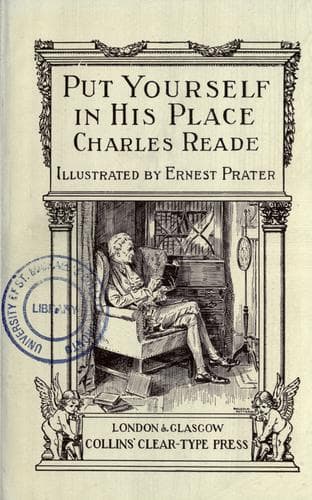
English fiction -- 19th century; Labor unions -- Fiction
But one thing soon became evident. He could not work his inventions
without a much larger capital.
Dr. Amboyne and he put their heads together over this difficulty, and
the doctor advised him in a more erudite style than usual.
“True invention,” said he, “whether literary or mechanical, is the
highest and hardest effort of the mind. It is an operation so absorbing
that it often weakens those pettier talents which make what we call the
clever man. Therefore the inventor should ally himself with some person
of talent and energy, but no invention. Thus supported, he can have his
fits of abstraction, his headaches, his heartaches, his exultations, his
depressions, and no harm done; his dogged associate will plow steadily
on all the time. So, after all, your requiring capital is no great
misfortune; you must look out for a working capitalist. No sleeping
partner will serve your turn; what you want is a good rich, vulgar,
energetic man, the pachydermatouser the better.”
Henry acted on this advice, and went to London in search of a moneyed
partner. Oh, then it was he learned--
“The hell it is in suing long to bide.”
He found capitalists particularly averse to speculate in a patent. It
took him many days to find out what moneyed men were open to that sort
of thing at all; and, when he got to them, they were cold.
They had all been recently bitten by harebrained inventors.
Then he represented that it was a matter of judgment, and offered
to prove by figures that his saw-grinding machines must return three
hundred per cent. These he applied to would not take the trouble to
study his figures. In another words, he came at the wrong time. And the
wrong time is as bad as the wrong thing, or worse.
Take a note of that, please: and then forget it.
At last he gave up London in despair, and started for Birmingham.
The train stepped at Tring, and, as it was going on again, a man
ran toward the third-class carriage Little was seated in. One of the
servants of the company tried to stop him, very properly. He struggled
with that official, and eventually shook him off. Meantime the train was
accelerating its pace. In spite of that, this personage made a run and
a bound, and, half leaping, half scrambling, got his head and shoulders
over the door, and there oscillated, till Little grabbed him with
both hands, and drew him powerfully in, and admonished him. “That is a
foolhardy trick, sir, begging your pardon.”
“Young man,” panted the invader, “do you know who you're a-speaking to?”
“No. The Emperor of China?”
“No such trash; it's Ben Bolt, a man that's bad to beat.”
“Well, you'll get beat some day, if you go jumping in and out of trains
in motion.”
“A many have been killed that way,” suggested a huge woman in the corner
with the meekest and most timid voice imaginable.
Mr. Bolt eyed the speaker with a humorous voice. “Well, if I'm ever
killed that way, I'll send you a letter by the post. Got a sweetheart,
ma'am?”
Public-domain text, read in full here on John Shaqi.
Reviews
Reviews
No reviews yet
Be the first to share your thoughts on this work.
Elsewhere in the archive
Join the Discussion
Join the discussion
Sign in to leave a comment or review.
Sign InorCreate an account