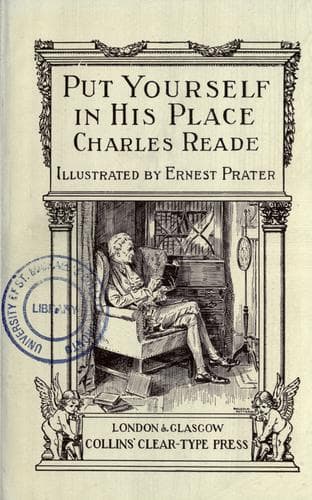
English fiction -- 19th century; Labor unions -- Fiction
With this rough advice the conference ended, and Mr. Coventry went home
thoroughly shaken in his purpose, and indeed not a little anxious on
his own account. Suppose he had been overheard! his offer to Cole was
an offense within reach of the criminal law. What a mysterious labyrinth
was this Trade confederacy, into which he had put his foot so rashly,
and shown his game, like a novice, to the subtle and crafty Grotait. He
now collected all his powers, not to injure Little, but to slip out of
his own blunder.
He seized this opportunity to carry out a coup he had long meditated: he
went round to a dozen timber-merchants, and contracted with them for the
sale of every tree, old or young, on his estate; and, while the trees
were falling like grain, and the agents on both sides measuring the
fallen, he vanished entirely from Hillsborough and Bollinghope.
Dr. Amboyne's influenza was obstinate, and it was nearly a fortnight
before he was strong enough to go to Cairnhope; but at last Mrs. Little
received a line from him, to say he was just starting, and would come
straight to her on his return: perhaps she would give him a cup of tea.
This letter came very opportunely. Bolt had never shown his face again;
and Henry had given up all hopes of working his patents, and had said
more than once he should have to cross the water and sell them.
As for Mrs. Little, she had for some time maintained a politic silence.
But now she prepared for the doctor's visit as follows: “So, then, you
have no more hopes from the invincible Mr. Bolt?”
“None whatever. He must have left the town in disgust.”
“He is a wise man. I want you to imitate his example. Henry, my dear,
what is the great object of your life at present? Is it not to marry
Grace Carden?”
“You know it is.”
“Then take her from my hands. Why do you look so astonished? Have you
forgotten my little boast?” Then, in a very different tone, “You will
love your poor mother still, when you are married? You will say, 'I owe
her my wife,' will you not?”
Henry was so puzzled he could not reply even to this touching appeal,
made with eyes full of tears at the thought of parting with him.
Mrs. Little proceeded to explain: “Let me begin at the beginning. Dr.
Amboyne has shown me I was more to blame than your uncle, was. Would
you believe it? although he refused your poor father the trust-money, he
went that moment to get L2000 of his own, and lend it to us. Oh, Henry,
when Dr Amboyne told me that, and opened my eyes, I could have thrown
myself at poor Guy's feet. I have been the most to blame in our unhappy
quarrel; and I have sent Dr. Amboyne to say so. Now, Henry, my brother
will forgive me, the doctor says; and, oh, my heart yearns to be
reconciled. You will not stand in my way, dearest?”
“Not likely. Why, I am under obligations to him, for my part.”
Public-domain text, read in full here on John Shaqi.
Reviews
Reviews
No reviews yet
Be the first to share your thoughts on this work.
Elsewhere in the archive
Join the Discussion
Join the discussion
Sign in to leave a comment or review.
Sign InorCreate an account