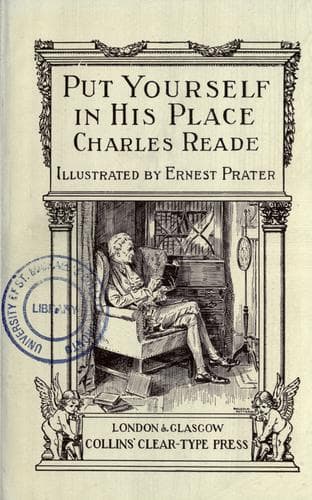
English fiction -- 19th century; Labor unions -- Fiction
“'Tis no fault of yourn, miss,” said Jael, rustic, but womanly.
“Then you are NOT happy here.”
No reply, but two clear eyes began to fill to the very brim.
Grace coaxed her, and said, “Speak to me like a friend. You know, after
all, you are not my servant. I can't possibly part with you altogether;
I have got to like you so: but, of course, you shall go home for a
little while, if you wish it very, very much.”
“Indeed I do, miss,” said Jael. “Please forgive me, but my heart feels
like lead in my bosom.” And, with these words, the big tears ran over,
and chased one another down her cheeks.
Then Grace, who was very kind-hearted, begged her, in a very tearful
voice, not to cry: she should go home for a week, a fortnight, a month
even. “There, there, you shall go to-morrow, poor thing.”
Now it is a curious fact, and looks like animal magnetism or something,
but the farm-house, to which Jael had felt so mysteriously drawn all
night, contained, at that moment, besides its usual inmates, one Henry
Little: and how he came there is an important part of this tale, which I
must deal with at once.
While Henry was still visiting Woodbine Villa, as related above, events
of a very different character from those soft scenes were taking place
at the works. His liberal offer to the Edge-Tool Forgers had been made
about a week, when, coming back one day from dinner to his forge, he
found the smoky wall written upon with chalk, in large letters, neatly
executed:--
“Why overlook the handlers?
“MARY.”
He was not alarmed this time, but vexed. He went and complained to
Bayne; and that worthy came directly and contemplated the writing, in
silence, for about a minute. Then he gave a weary sigh, and said, with
doleful resignation, “Take the chalk, and write. There it is.”
Henry took the chalk, and prepared to write Bayne's mind underneath
Mary's. Bayne dictated:
“I have offered the Handlers the same as the Forgers.”
“But that is not true,” objected Henry, turning round, with the chalk in
his hand.
“It will be true, in half an hour. We are going to Parkin, the Handlers'
Secretary.”
“What, another L15! This is an infernal swindle.”
“What isn't?” said Bayne, cynically.
Henry then wrote as desired; and they went together to Mr. Parkin.
Mr. Parkin was not at home. But they hunted him from pillar to post,
and caught him, at last, in the bar-parlor of “The Packsaddle.” He knew
Bayne well, and received him kindly, and, on his asking for a private
interview, gave a wink to two persons who were with him: they got up
directly, and went out.
“What, is there any thing amiss between you and the trade?” inquired Mr.
Parkin, with an air of friendly interest.
Public-domain text, read in full here on John Shaqi.
Reviews
Reviews
No reviews yet
Be the first to share your thoughts on this work.
Join the Discussion
Join the discussion
Sign in to leave a comment or review.
Sign InorCreate an account