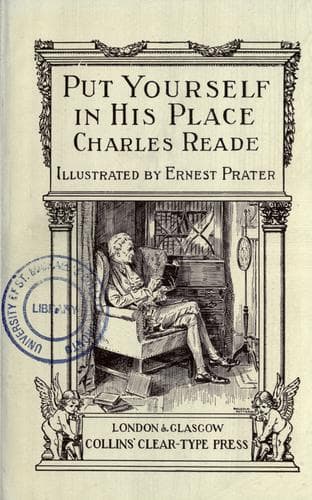
English fiction -- 19th century; Labor unions -- Fiction
He sauntered about, and examined all the shops with lack-luster eye. He
looked in at everything, but observed nothing, scarcely saw anything.
All his senses were turned inward. It was such a pitiable and galling
result of a gallant fight. Even the insurance office had got the better
of him. It had taken one-third of his savings, and the very next day his
trade was gone, and his life in no danger. The “Gosshawk” had plucked
him, and the trade had tied his hands. Rack his invention how he would,
he could see no way of becoming a master in Hillsborough, except by
leaving Hillsborough, and working hard and long in some other town. He
felt in his own heart the love and constancy to do this; but his reason
told him such constancy would be wasted; for while he was working at a
distance, the impression, if any, he had made on her would wear away,
and some man born with money, would step in and carry her gayly off.
This thought returned to him again and again, and exasperated him so at
last, that he resolved to go to “Woodbine Villa,” and tell her his heart
before he left the place. Then he should be rejected, no doubt, but
perhaps pitied, and not so easily forgotten as if he had melted silently
away.
He walked up the hill, first rapidly, then slowly. He called at
“Woodbine Villa.”
The answer was “Not at home.”
“Everything is against me,” said he.
He wandered wearily down again, and just at the entrance of the town
he met a gentleman with a lady on each arm, and one of those ladies was
Miss Carden. The fortunate cavalier was Mr. Coventry, whom Henry would
have seen long before this, but he had been in Paris for the last four
months. He had come back fuller than ever of agreeable gossip, and Grace
was chatting away to him, and beaming with pleasure, as innocent girls
do, when out on a walk with a companion they like. She was so absorbed
she did not even see Henry Little. He went off the pavement to make room
for their tyrannical crinolines, and passed unnoticed.
He had flushed with joy at first sight of her, but now a deadly qualm
seized him. The gentleman was handsome and commanding; Miss Carden
seemed very happy, hanging on his arm; none the less bright and happy
that he, her humble worshiper, was downcast and wretched.
It did not positively prove much; yet it indicated how little he must
be to her: and somehow it made him realize more clearly the great
disadvantage at which he lay, compared with an admirer belonging to her
own class. Hitherto his senses had always been against his reason: but
now for once they co-operated with his judgment, and made him feel that,
were he to toil for years in London, or Birmingham, and amass a fortune,
he should only be where that gentleman was already; and while the
workman, far away, was slaving, that gentleman and others would be
courting her. She might refuse one or two. But she would not refuse them
all.
Then, in his despair, he murmured, “Would to God I had never seen her!”
Public-domain text, read in full here on John Shaqi.
Reviews
Reviews
No reviews yet
Be the first to share your thoughts on this work.
Elsewhere in the archive
Join the Discussion
Join the discussion
Sign in to leave a comment or review.
Sign InorCreate an account