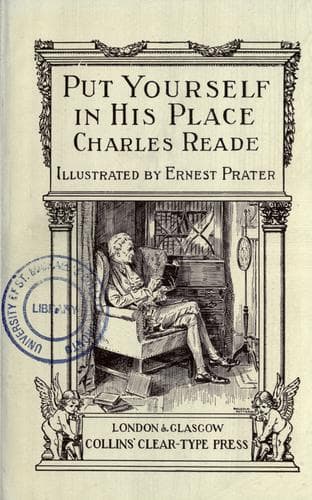
English fiction -- 19th century; Labor unions -- Fiction
He made a fierce resolve he would go home, and tell his mother she could
pack up.
He quickened his steps, for fear his poor sorrowful heart should falter.
But, when he had settled on this course, lo! a fountain of universal
hatred seemed to bubble in his heart. He burned to inflict some mortal
injury upon Jobson, Parkin, Grotait, Cheetham, and all who had taken
a part, either active or passive, in goading him to despair. Now Mr.
Cheetham's works lay right in his way; and it struck him he could make
Cheetham smart a little. Cheetham's god was money. Cheetham had thrown
him over for money. He would go to Cheetham, and drive a dagger into his
pocket.
He walked into the office. Mr. Cheetham was not there: but he found
Bayne and Dr. Amboyne.
“Mr. Bayne,” said he, abruptly, “I am come for my month's wages.”
The tone was so aggressive, Bayne looked alarmed. “Why, Little, poor Mr.
Cheetham is gone home with a bad headache, and a sore heart.”
“All the better. I don't want to tell him to his face he is a bragging
cur; all I want out of him now is my money; and you can pay me that.”
The pacific Bayne cast a piteous glance at Dr. Amboyne. “I have told you
the whole business, sir. Oughtn't Mr. Little to wait till to-morrow, and
talk it over with Mr. Cheetham? I'm only a servant: and a man of peace.”
“Whether he ought or not, I think I can answer for him that he will.”
“I can't, sir,” said Henry, sturdily. “I leave the town to-morrow.”
“Oh, that alters the case. But must you leave us so soon?”
“Yes, sir.”
“I am very sorry for that. Tell me your reason. I don't ask out of mere
curiosity.”
Henry replied with less than his usual candor; “Is it not reason enough
for leaving a place, that my life has been attempted in it, and now my
livelihood is taken?”
“Those are strong reasons. But, on the other hand, your life is no
longer in danger; and your livelihood is not gone; for, to speak
plainly, I came over here the moment I heard you were discharged, to
ask if you would enter my service on the same terms as Mr. Cheetham gave
you, only guineas instead of pounds.”
“What, turn doctor?”
“Oh dear, no; the doctors' Union would forbid that. No, Mr. Little, I am
going to ask you to pay me a compliment; to try my service blindfold for
one week. You can leave it if you don't like it; but give me one week's
trial.”
“How can I refuse you that?” said Henry, hanging his head. “You have
been a good friend to me. But, sir, mark my words, this place will be my
destruction. Well, when am I to begin work?”
“To-morrow, at ten.”
“So be it,” said Henry, wearily, then left the works and went home;
but, as he went, he said to himself. “It is not my doing.” And his
double-faced heart glowed and exulted secretly.
He told his mother how the Trades had beaten him, and he was out of
work.
Mrs. Little consoled him hypocritically. She was delighted. Then he told
her his departure had been delayed by Dr. Amboyne: that made her look a
little anxious.
Public-domain text, read in full here on John Shaqi.
Reviews
Reviews
No reviews yet
Be the first to share your thoughts on this work.
Elsewhere in the archive
Join the Discussion
Join the discussion
Sign in to leave a comment or review.
Sign InorCreate an account