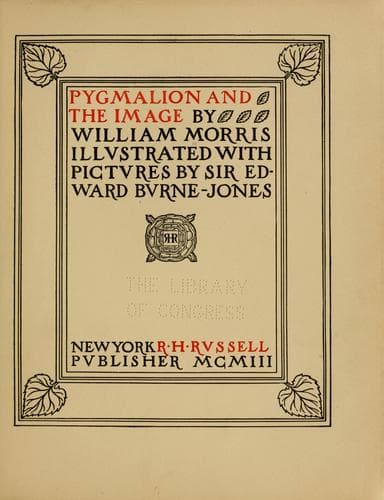
English poetry -- 19th century; Pygmalion (Greek mythology) -- Poetry
In regard to the poem itself, the inspiration of these pictures, even
the most casual study will bring in its train a conviction that the
story as told by William Morris is far superior to any other version
of classic or of modern times. The poem (one of the best of those
comprised in _The Earthly Paradise_) is homogeneous and admirably
balanced in all its parts; its superiority, however, over all other
versions, is not due primarily to the manner of its narration, but
arises from its greater spirituality--a finer feeling rather than a
finer form. Prior to the appearance of "Pygmalion and the Image" each
narrator of the legend had dwelt mainly on the physical side, sensuous
or sensual according to his temperament, of the tale. In Morris's
version the dominant note is the passionate delight--enthusiasm verging
upon madness--of the artist and craftsman in his own handiwork,
reflecting, to a marked degree, Morris's own temperament, one of the
leading characteristics of which was his habit of hurling himself
headlong into each new project as it claimed his attention from time
to time. That he was prevented thereby from arriving at perfection
in any one art need not lessen the admiration due to him for his
whole-souled (though usually short-lived) absorption in many and
diverse arts. A great poet, in the sense that Chaucer, his master
and model, was great, Morris was not; but no one can deny to him the
title of an enthusiastic and skilled craftsman of verse. It is this
love of craftsmanship for its own sake, joined to a remarkable feeling
for decorative beauty which both possessed, that binds the pictures
of Burne-Jones and this poem by Morris so closely together that they
form one perfect whole. Even the ideal and wholly imaginary world in
which their figures move is the same--a land where emotion rather than
passion bears sway, where the fates of man and of woman are determined
by a whim of the gods rather than dominated by the chivalrous or devout
hardihood of the individual.
In his "Apology" prefixed to _The Earthly Paradise_, Morris clearly and
definitely disclaims any moral purpose in the poems comprised in it.
Public-domain text, read in full here on John Shaqi.
Reviews
Reviews
No reviews yet
Be the first to share your thoughts on this work.
Join the Discussion
Join the discussion
Sign in to leave a comment or review.
Sign InorCreate an account