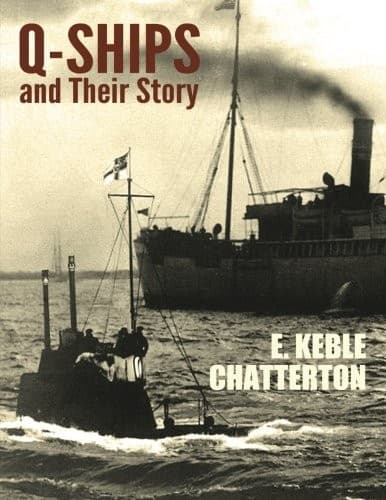
Q-Ships and Their StoryChatterton, E. Keble (Edward Keble)
History
Q-Ships and Their Story
Chatterton, E. Keble (Edward Keble)
Q-ships; World War, 1914-1918 -- Naval operations
The facts which have just been stated are authentic, and it is as well
that they should now be made known. Ignorance always breeds falsehood,
and after the loss of _Prize_ there were all sorts of wild stories
going about both in the Service and in the Mercantile Marine. Some of
them are too ghastly to be related, but a favourite version was that
the brave Sanders had been taken prisoner and lashed to the submarine’s
periscope, which then submerged and so drowned him. Another story,
which was very prevalent, was that he had been cruelly murdered. There
is not a word of truth in these suggestions. Lieut.-Commander Sanders
died as he would have wished, aboard his ship with his men. His body
rests in the Atlantic where the remains of his glorious _Prize_ sank:
but his memorial, unveiled by Lord Jellicoe as Governor of New Zealand,
will inspire generations who come after.
For dogged devotion to dangerous duty, for coolness in peril, for real
leadership of men, for tenacity in ‘sticking it,’ this hero among
those great and gallant gentlemen of the Q-ship service will remain
as a model of what a true British sailor should be. Had he lived, his
influence would have been tremendous, but by his refusing a safe billet
when he was fully entitled to it, and preferring deliberately to court
death because that way duty and honour pointed, his example should be a
great source of strength to every young apprentice beginning his life
in the Merchant Service, every midshipman of His Majesty’s Navy, and
every young man content to learn the lessons which are taught only by
the sea. On land, for their historic exploits at the Dardanelles and
in France we gratefully remember the Australians and New Zealanders.
It is fitting that one of the latter should have bequeathed to us such
distinction on the sea: it is characteristic of the great co-operation
when the children of the Empire flocked to help their mother in her
throes of the World War.
CHAPTER XII
SHIPS AND ADVENTURES
Independence of character is a great asset in any leader of men, but it
is an essential, basic virtue when a man finds himself in command of a
ship: without such an attribute he is dominated either by his officers,
his own emotions, or the vagaries of chance. In the case of a Q-ship
captain, this aloofness was raised to a greater degree of importance
by reason of the special nature of the work. Can you think of any
situation more solitary and lonely than this? There are, of course,
all kinds and conditions of loneliness. There is the loneliness of
the airman gliding through celestial heights; there is the loneliness
of the man in the crowd; there is the loneliness of the sentry, of
the hermit, of the administrator in the desert. But I can conceive of
nothing so solitary as the Q-ship captain lying alone on the planking
of his bridge, patiently waiting and watching through a slit in the
canvas the manœuvres of an artful U-boat.
Public-domain text, read in full here on John Shaqi.
Reviews
Reviews
No reviews yet
Be the first to share your thoughts on this work.
Elsewhere in the archive
Join the Discussion
Join the discussion
Sign in to leave a comment or review.
Sign InorCreate an account