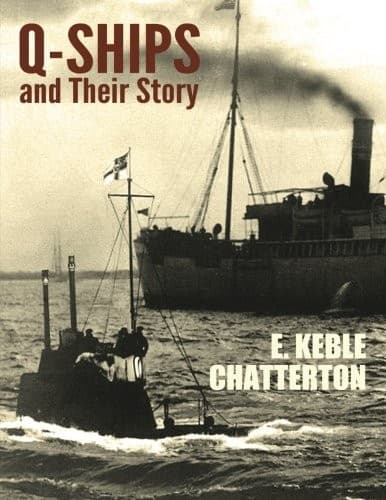
Q-Ships and Their StoryChatterton, E. Keble (Edward Keble)
History
Q-Ships and Their Story
Chatterton, E. Keble (Edward Keble)
Q-ships; World War, 1914-1918 -- Naval operations
On the forenoon of August 13, imagine this schooner with her
newly-painted black topsides and red boot-topping, flying the Swedish
flag and heading east. Suddenly UB 48 was sighted to the north, so
Sanders hove-to and signalled the British submarine that there was a
German submarine to port. Shells began to be fired from the enemy, who
closed. The British submarine saw the shots falling but could not see
the enemy until 4.10 p.m., when the German was descried to starboard of
the _Prize_. There was a considerable lop on at the time, and _Prize_
was seen with White Ensign flying at the peak, and her guns manned.
Five hours later the British submarine came to the surface and spoke
_Prize_, who stated that she had opened fire on the enemy at 200 yards,
and had hit him. This we now know from another source was perfectly
true, but the hits were not in a vital part of the German. During the
dark hours UB 48 bided his time, and at midnight fired two torpedoes,
the second of which hit, causing a terrific explosion, so that nothing
more was seen, and the good ship _Prize_, with her gallant captain and
all his brave men, ended her career after one of the most brilliant
periods that can be found in the records of sea achievement. UB 48 was
on her maiden voyage from Germany via the north of Scotland and N.W.
of Ireland to Cattaro in the Adriatic, where she arrived on September
2, sinking merchantmen on the way. This modern type of submarine, with
her 4·1-inch gun and her ten torpedoes, was a difficult craft to sink.
Her second officer had been taken from the German Mercantile Marine,
so we can assume that his critical eye would scrutinize the schooner
and detect something which convinced his captain that this was really
a trap-ship. That the submarine should have been content, whilst on a
long passage, to waste so many hours over a mere sailing craft of quite
small tonnage would have been doubtful; but the _Prize_ having once
shown her White Ensign and used her guns to effect decided the German
that she must be settled with after dark, when she would be a good
target in that August night. It was a fair fight, but the chances were
all in favour of the German, since it is practically impossible to see
a periscope at night, whereas the Q-ship’s sails would loom up and show
in which direction the target was heading; and, further, the submarine
had the advantage of mobility all the time.
Public-domain text, read in full here on John Shaqi.
Reviews
Reviews
No reviews yet
Be the first to share your thoughts on this work.
Elsewhere in the archive
Join the Discussion
Join the discussion
Sign in to leave a comment or review.
Sign InorCreate an account