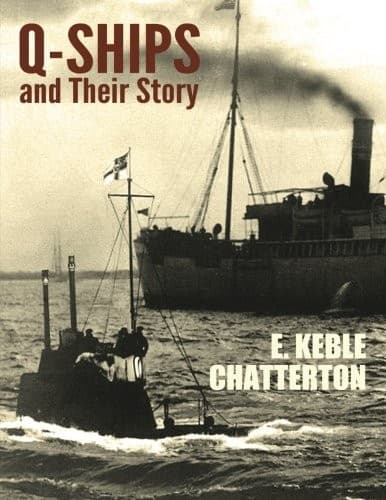
Q-Ships and Their StoryChatterton, E. Keble (Edward Keble)
History
Q-Ships and Their Story
Chatterton, E. Keble (Edward Keble)
Q-ships; World War, 1914-1918 -- Naval operations
_Acton_ had an indecisive duel with a submarine on August 20, 1917. It
was a fine day with a calm sea when the enemy was sighted, and on being
attacked _Acton_ abandoned ship. In order to make this doubly real,
fire-boxes were started in the well-deck, and steam leakage turned on,
which made the ship look as if she were on fire. The enemy inspected
the ship closely, so closely in fact that he actually collided with
_Acton_, shaking the latter fore and aft. But after he had come to the
surface and _Acton_ opened fire, hitting, loud shouts came from the
conning-tower, and he submerged, thus escaping. _Acton_ went on with
her work until the end of hostilities.
_Zylpha_ and _Cullist_ both had tragic ends to their careers. _Zylpha_
was a 2,917-ton steamer, built at Sunderland in 1894, and had been
commissioned as a Q-ship as far back as October, 1915. Early in June,
1917, she steamed along the south Irish coast and then out into the
Atlantic, as if bound for New York. On June 11, at 9.45 a.m., when
about 200 miles from the Irish coast, she was torpedoed by a submarine
that was never seen again, and totally disabled. Her engines had
stopped for the last time, and the sea had poured in, though her
closely-packed cargo of wood was at present keeping her afloat. Having
‘bleated’ with her wireless, one of the United States destroyers, based
on Queenstown, proceeded to her assistance. This was the _Warrington_,
and she stood by the ship for a whole twenty-four hours—from 2 p.m. of
the eleventh until 2.30 p.m. of the twelfth. By the time _Warrington_
had arrived _Zylpha’s_ engine-room and boiler-rooms were already awash,
Nos. 2 and 3 holds flooded, the wireless out of action, and one man
killed. The _Warrington_ kept patrolling round her, requested a tug by
wireless, and went on zigzagging through the long hours. By the evening
_Zylpha_ was in a bad way, and the Atlantic swell was seriously shaking
the bulkheads, but she was still afloat next morning. By this time the
_Warrington_, who had been some time on patrol, was running short of
oil, so, at 2.30 p.m., regretfully had to return to harbour for fuel.
This was a sad blow to the _Zylpha_ people, but whilst waiting for the
arrival of the U.S. destroyer _Drayton_ and two Queenstown tugs which
were being sent to her, _Zylpha_ actually made sail with what little
canvas she had, and made good at 1-1/2 knots. At noon of the fourteenth
she was picked up by H.M. sloop _Daffodil_, and was then taken in tow.
Next day, at 1 p.m., tugs reached her, but she could not last out
the night, and, after having been towed for most of 200 miles, she
gradually sank when quite near to the west coast, finally disappearing
at 11.20 p.m. near the Great Skelligs. So ended _Zylpha_.
Public-domain text, read in full here on John Shaqi.
Reviews
Reviews
No reviews yet
Be the first to share your thoughts on this work.
Elsewhere in the archive
Join the Discussion
Join the discussion
Sign in to leave a comment or review.
Sign InorCreate an account