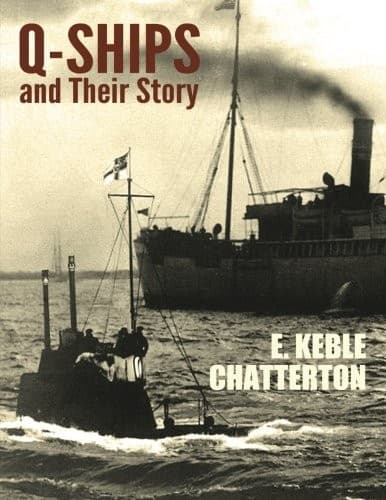
Q-Ships and Their StoryChatterton, E. Keble (Edward Keble)
History
Q-Ships and Their Story
Chatterton, E. Keble (Edward Keble)
Q-ships; World War, 1914-1918 -- Naval operations
_Cullist_ was commanded by an officer who had served a long time off
this coast in a sloop. Her real name was the _Westphalia_, but she was
also known as the _Jurassic_, _Hayling_, and _Prim_. She was of 1,030
gross tons, and in the spring of 1917 was lying at Calais, when she was
requisitioned and sent to Pembroke Naval Dockyard to be fitted out. She
was commissioned on May 12 by Lieut.-Commander Simpson, and Admiral
Bayly then sent her to cruise along certain trade routes. She was
capable of steaming about 10 knots, and was armed with a 4-inch and two
12-pounder guns, as well as a couple of torpedo-tubes, and all these
had been well concealed. A few weeks later, on July 13, _Cullist_ was
between the Irish and French coasts, and it was just after 1 p.m. when
a submarine appeared on the horizon.
About two minutes later the enemy from very long range opened fire,
but as his shots were falling about 3,000 yards short, he increased
speed towards the _Cullist_. By 1.30 a large merchant ship was seen
coming up from the south, so _Cullist_ hoisted the signal ‘You are
standing into danger,’ whereupon the big steamer altered course away.
_Cullist_ then zigzagged, keeping always between sun and enemy, and by
dropping eight smoke-boxes at various intervals succeeded in enticing
the submarine down to a range of 5,000 yards, a distance which was
maintained for the rest of the action. From 1.45 the enemy continually
straddled _Cullist_ so that the decks were wet with the splashes, and
shell splinters were rattling on masts and deck. By 2.7 the enemy
had fired sixty-eight rounds, but had not hit once. _Cullist_ now
decided to engage, and her third round was seen to hit just below the
submarine’s gun, the remainder hitting regularly along the deck and on
the conning-tower, causing bright red flames which rose higher than
the conning-tower. Three minutes after _Cullist_ had opened fire the
enemy sank by the bows in flames, and then the ship steamed to the spot
and dropped a depth charge. Three of _Cullist’s_ crew saw a corpse
dressed in blue dungarees, floating face upwards, but the submarine was
never seen again. By 3.30 H.M.S. _Christopher_ arrived on the scene
and both ships searched for the enemy. He was evidently seriously
damaged, but he had made his escape. Lieut.-Commander Simpson, for
this engagement, was awarded a D.S.O; Lieutenant G. Spencer, R.N.R., a
D.S.C.; Sub-Lieutenant G. H. D. Doubleday, R.N.R., also a D.S.C.; while
two other officers were ‘mentioned.’
Public-domain text, read in full here on John Shaqi.
Reviews
Reviews
No reviews yet
Be the first to share your thoughts on this work.
Elsewhere in the archive
Join the Discussion
Join the discussion
Sign in to leave a comment or review.
Sign InorCreate an account