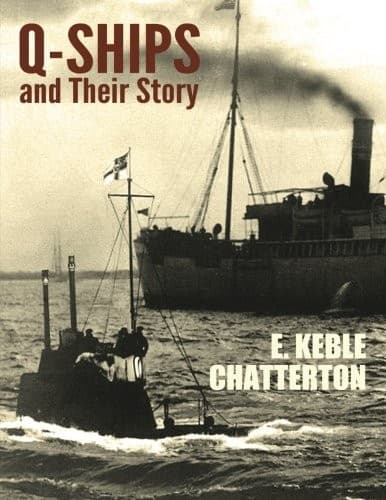
Q-Ships and Their StoryChatterton, E. Keble (Edward Keble)
History
Q-Ships and Their Story
Chatterton, E. Keble (Edward Keble)
Q-ships; World War, 1914-1918 -- Naval operations
_Cullist’s_ next adventure was on August 20 in the English Channel,
when she was shelled for most of two and a half hours at long range,
during which the submarine expended over eighty rounds with only one
hit. This, however, had penetrated the waterline of the stokehold,
injuring both firemen who happened to be on watch, and causing a large
rush of water into the stokehold. By plugging the hole and shoring it
up this defect was for the present made good. At 7.25 p.m., inasmuch as
the light was fading and the enemy declined to come nearer than 4,000
yards, _Cullist_ started shelling and seemed to make two direct hits on
the base of the conning-tower. This was enough for the German, who then
dived very rapidly and made off. _Cullist_ was practically uninjured,
for the only other hits on her had been that the port depth charge had
been struck with shell splinters and the patent log-line had been shot
away.
But on the eleventh of the following February a much more serious
attack was made, and this illustrates the statement that suddenly
without the slightest warning a Q-ship might find herself in the
twinkling of an eye changed from an efficient man-of-war into a mere
wreck. _Cullist_ at the time was steaming on a southerly course
down the Irish Sea, Kingstown Harbour being to the westward. The
officer of the watch and the look-out men were at their posts,
and Lieut.-Commander Simpson was walking up and down the deck.
Suddenly, from nowhere, the track of a torpedo was seen approaching,
and this struck the ship between the engine-room and No. 3 hold.
Lieut.-Commander Simpson was hurled into the air and came down on to
the edge of the deck with a very painful arm. Realizing the condition
of the _Cullist_, he ordered his men to abandon ship, but such was the
zeal of the crew in remaining at action stations until the last moment
that many of them were drowned: for in less than two minutes _Cullist_
had gone to the bottom. This part of the Irish Sea then consisted of
a number of Englishmen swimming about or keeping alive on a small
Carley float. The submarine when half a mile astern of where _Cullist_
sank, came to the surface and rapidly approached. Then she stopped,
picked up two men, inquired for the captain, examined survivors through
glasses, and having abused them by words and gestures, made off to
the southward. After swimming about for some time, Lieut.-Commander
Simpson was then pulled on to the Carley float, which is a special
kind of raft, very shallow, painted Navy grey, and usually supplied
with a paddle such as you find in a Canadian canoe. It was a bleak
February afternoon, and here were a few men able to keep from death by
joining hands on this crowded raft. As the hours went on, the usual
trying thirst assailed them and the fatal temptation to drink the
sea-water, but the captain wisely and sternly prevented this. How long
they would be left crowded in this ridiculous raft, cold and miserable,
Public-domain text, read in full here on John Shaqi.
Reviews
Reviews
No reviews yet
Be the first to share your thoughts on this work.
Elsewhere in the archive
Join the Discussion
Join the discussion
Sign in to leave a comment or review.
Sign InorCreate an account