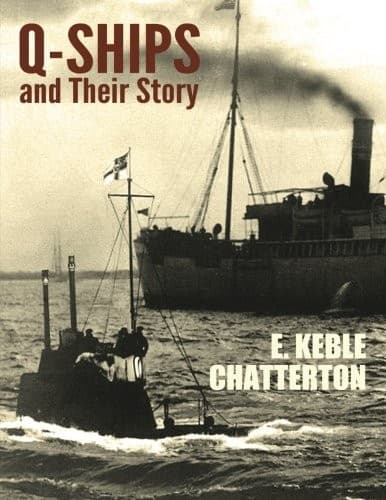
Q-Ships and Their StoryChatterton, E. Keble (Edward Keble)
History
Q-Ships and Their Story
Chatterton, E. Keble (Edward Keble)
Q-ships; World War, 1914-1918 -- Naval operations
the biggest U-class submarines, 230 feet long, armed with two guns and
twelve torpedoes. The whole incident, from the moment the torpedo was
fired to the destruction of the attacker, had covered forty minutes;
but now, ten minutes later, _Privet’s_ engine-room was reported to be
filling up with water owing to one of the enemy’s shells getting home.
Twenty minutes later the chief engineer reported that the water was now
over the plates and rising. Efforts were made to plug the hole with
hammocks and timber, but this was found impossible, and this small
ship, in spite of her victory, was in great peril. After another few
minutes the men and wounded were ordered into the lifeboat and skiff,
for the engine-room was full of water and the after bulkhead might give
way suddenly any minute. Half an hour later this actually happened, but
by this time the two British destroyers _Christopher_ and _Orestes_ had
arrived on the scene.
_Privet_ was in a pitiable condition, and, after throwing overboard
confidential books and rendering the depth charges safe, she was
finally abandoned, though she did not at once sink. In fact, an hour
and a half later she was still afloat; so Lieut.-Commander Matheson,
his officers, a seaman, and a working party from _Orestes_ went back
on board her, and within an hour _Orestes_ had begun to tow her
under great difficulties. However, everything went fairly well until
they were approaching Plymouth Sound, when _Privet’s_ last bulkheads
collapsed, and she started now to settle down quickly. This was rather
hard luck, having regard to what she had gone through, but there was no
mistake about it, she was sinking fast. Those in charge of her are to
be congratulated, for they were able just in time to get her into shoal
water, and she sank in only 4-1/2 fathoms opposite the Picklecomb Fort,
and that closed chapter one in her not uninteresting career.
From this position she was very soon raised, taken into Devonport, and
recommissioned at the end of April. Thus, having sunk a submarine and
herself being sunk, she returned to the same kind of work, and actually
succeeded in sinking another submarine on the night of November 8-9,
1918, this being the last to be destroyed before Armistice. The
incident occurred in the Mediterranean and the submarine was U 34.
Truly a remarkable career for such a small steamer, but a great tribute
to all those brains and hands who in the first instance fitted her out,
fought in her, got her into Plymouth Sound, salved her, fitted her out
again, took her to sea, and undauntedly vanquished the enemy once more!
In the whole realm of naval history there are not many ships that can
claim such a record against an enemy.
Public-domain text, read in full here on John Shaqi.
Reviews
Reviews
No reviews yet
Be the first to share your thoughts on this work.
Elsewhere in the archive
Join the Discussion
Join the discussion
Sign in to leave a comment or review.
Sign InorCreate an account